
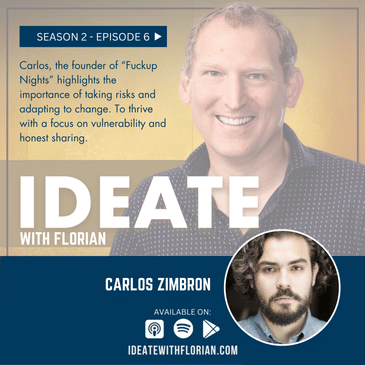

BIO
Carlos Zimbrón, an Architect graduate from Universidad Iberoamericana, stands as a co-founder and Executive Director of Fuckup Nights, The Failure Institute, and Women Unfiltered. Alongside these impactful initiatives, he is a co-founder and board member of WE ARE TODOS, a cultural and creative development space established in Mexico City in 2010. In 2016, Carlos expanded his ventures by founding WAT Studio, an architecture and design firm specializing in technological experiences. Beyond his professional pursuits, Carlos finds balance in his personal life. Engaging in football three times a week, he dedicates time to his passion for drawing and occasional painting.
SHOW NOTES
In this episode of the “Ideate with Florian” podcast, Carlos and Florian discuss the global success of "Fuck Up Nights," a movement born from a casual BBQ in Mexico City. The initiative, now in around 260 cities, promotes embracing failure as a universal learning experience. Carlos highlights the importance of taking risks and adapting to change, emphasizing the movement's organic growth driven by a supportive community. The conversation also touches on challenges faced during growth, and how to handle this. Despite hurdles, the movement thrives with a focus on vulnerability and honest sharing. Carlos concludes by envisioning the initiative's future, aiming to disappear as an organization when no longer needed, having successfully reshaped the global perspective on failure.
Share:
Subscribe:
[00:00:06] Hello, Dreamers, thinkers and viewers welcome to Ideated Florian
[00:00:10] In this season with the Scuffer Workout Ideas come from, whether it's for a new feature, product or company
[00:00:16] I'm your host Florian Hoornaar for over 25 years I work with small and medium-sized companies
[00:00:22] In engineering, sales and management during the time I connected with many professionals to grow together
[00:00:28] That makes me excited to explore the journeys of our guest with you, so let's dive in!
[00:00:34] Episode 6, Celebrating Bad Ideas at Fuckup Nights with Carlos Zimbron
[00:00:39] In this episode of the Ideated Florian podcast we welcome Carlos Zimbron, founder of Fuckup Nights
[00:00:46] We discussed the global success of Fuckup Nights, a movement born from a casual barbecue and Mexico city
[00:00:53] The initiative now we're around 260 cities, promotes embracing failure as a universal learning experience
[00:01:00] Carlos highlights the importance of taking risks and adapting to change
[00:01:04] Emphasizing the movement organic growth driven by a supportive community
[00:01:09] The conversation also touches on challenges faced during growth and how to handle this
[00:01:14] Despite hurdles, the movement thrives with a focus on vulnerability and honest sharing
[00:01:20] Carlos concludes by envisioning the initiative's future, aiming to disappear as an organization
[00:01:25] when no longer needed, having successfully reshaped the global perspective of failure
[00:01:34] Welcome Carlos
[00:01:35] I've learned a lot from the invitation
[00:01:38] I'm so happy to be talking to you because you started something that really became successful
[00:01:42] By talking about things that are really not successful
[00:01:45] So there's a very interesting paradox
[00:01:47] I can introduce Fuckup Nights for it's probably more entertaining if you introduce Fuckup Nights
[00:01:52] And what is it?
[00:01:54] It's crazy that an idea that came from the concept of failure became now success
[00:02:02] First, it's kind of difficult to explain that all the time that we're having success to a failure
[00:02:08] But yeah, we started basically the idea came out in a barbecue
[00:02:13] We were kind of drunk one night, we were drinking some Mexican in the sky
[00:02:19] In Mexico City because in that time I was at an all 25th century, it's actually a whole day
[00:02:25] And we were like, you know, creating things and we are like these creative minds
[00:02:30] We're like with a lot of ideas and a lot of stamina and everything and trying to do whatever
[00:02:36] We were excited about it
[00:02:39] And we were in a barbecue, you know, that idea that came out after a couple of drinks
[00:02:44] And in that moment sounds like great ideas, but then they after
[00:02:49] They are not that good
[00:02:51] This one was a good idea and realized that we have potential projects in hands
[00:02:59] The day after in the hangover, you know, like talking about the day before
[00:03:04] And we were like, we have something here
[00:03:06] I don't know what exactly is but we have something here
[00:03:09] The idea actually was we came out with the name the same day of the barbecue
[00:03:15] That's why it was like so appealing because we already had, you know, like the whole concept in two seconds
[00:03:22] So we decided to try it between the five of us, we are five founders
[00:03:28] In that moment we decided just to share our own failures and try the concepts in a really small scale
[00:03:36] It was crazy how that moment was that we were super good
[00:03:41] It was like really funny
[00:03:43] I know, so kind of sad and empathetic
[00:03:47] And you know, like a lot of feelings came from the story of my friends
[00:03:53] You know, the friends that I knew from for a long time
[00:03:57] And it was the first time we were listening that stories from us
[00:04:01] So yeah, it was night
[00:04:04] So the idea is that of the fuck up now is that some person goes on stage
[00:04:10] And shares his failure is fuck up with a whole bunch of strangers
[00:04:15] In a five-ton minutes presentation
[00:04:18] Was that also the format that you thought about on that barbecue
[00:04:22] And that next day that you did a bit of a group of friends?
[00:04:24] Yeah, like after that, first experience of for not to fuck up nights, you know
[00:04:32] And we decided to create a format like immediately
[00:04:36] Because we had jobs, you know, like our daily ups
[00:04:41] So we decided to make it simple to keep it simple in the most extreme way
[00:04:48] And with your decides in format, you mentioned it was five minutes, five to ten minutes
[00:04:56] Really short period of time
[00:04:59] Then ten images and every image
[00:05:04] It wasn't a presentation, it was more like a guidance for your story
[00:05:09] Because we are here, we are storytellers in that way
[00:05:12] We are trying to share story
[00:05:14] And that images were like just helping the storytelling
[00:05:20] That was it, the first fuck up night we had
[00:05:23] We were trying to do a global movement in that moment
[00:05:27] He was just like one night in Mexico City
[00:05:32] That was our expectation in that moment
[00:05:36] And it became like a really great night with the people
[00:05:40] Really small events, you know, some beers in the side
[00:05:44] Projector, we insist a lot with friends to come
[00:05:47] Because the idea was like, what?
[00:05:50] I don't know, I don't think it's necessarily something that I needed my life
[00:05:54] You've got a lot of failures
[00:05:56] So it was kind of difficult but it was magical in that way
[00:06:00] Also like the people where they were super at the end of the night
[00:06:05] We're trying about the concept and the vulnerability
[00:06:10] The guitarists and everything
[00:06:12] Right, and what I find so amazing about your story is that
[00:06:15] It's not like you took months to come up with an idea
[00:06:18] It was just that there were some creative fluids involved
[00:06:23] And it's pretty bad, but immediately I didn't idea
[00:06:26] You had a concept, you had a name, fuck up night you next day
[00:06:29] You had a format for it
[00:06:30] So it went so quickly that people spent months and years finding an idea
[00:06:35] It almost seems like the idea found you
[00:06:37] Yeah, totally
[00:06:38] I think that was part of our success that we just made it
[00:06:41] And we didn't think about it
[00:06:43] And we didn't ask if it was a good idea to anyone
[00:06:46] You saw it right
[00:06:48] You know, of course a lot of problems came after
[00:06:52] When we became successful and we had more than
[00:06:57] 260 cities around the world
[00:07:00] That's a problem
[00:07:02] You know that idea that started, you know like really fast
[00:07:05] And you have to change everything and you have to adapt everything
[00:07:08] To really manage global movements and a company and everything
[00:07:13] To pass from that moment of 70 BT and over a
[00:07:17] Comment and to became something more formal and real
[00:07:22] Taking us from there, the just a brand name itself
[00:07:26] Fuck up nights
[00:07:27] There's a rebellious stone to it
[00:07:29] Was it also a deliberate choice or
[00:07:32] Let's just fuck it, the way it's just a fuck up
[00:07:35] Let's go with this or how did that sound
[00:07:37] Yeah, we were the name came so fast
[00:07:40] We didn't think much about it
[00:07:41] We liked it and we thought you was
[00:07:43] Punk enough for us in that moment
[00:07:46] It was kind of anti-establishment with some ways
[00:07:50] Yes, but we didn't think about that much
[00:07:53] We were just young people trying to create something new
[00:07:57] And you're a reverend and different
[00:07:59] And I think that's like the DNA of young people
[00:08:04] We followed that hunch and that feeling
[00:08:08] We was okay, we didn't think much about it
[00:08:11] And we have a lot of surprises after that
[00:08:15] When people have problems with our name
[00:08:18] Because at the beginning
[00:08:20] It was with our friends and it was okay for them
[00:08:23] Like it was cool actually
[00:08:25] But then we started talking or tried to work with
[00:08:28] Organizations, with corporations, with everything
[00:08:32] And we tried to launch or write a book with a editorial
[00:08:37] And it was a problem
[00:08:39] It became a problem
[00:08:41] Even in social media
[00:08:43] We have a lot of problems there with that
[00:08:45] We cannot use ads
[00:08:48] We cannot buy ads
[00:08:49] Because we have a sort in our name
[00:08:53] So we just re-branded screw up
[00:08:56] Yeah, and we don't like that
[00:08:58] But sometimes we have to avoid in any ways
[00:09:01] We just make it happen
[00:09:03] But at the beginning we didn't think much about
[00:09:05] The name was just like fun and cool
[00:09:09] So how many people did you start?
[00:09:11] And that's first, was it a group of five or six
[00:09:13] How many did you say it was?
[00:09:15] Exactly, we are five founders
[00:09:17] And we started the first probably one year and a half
[00:09:23] We were just like the five of us doing everything
[00:09:26] And trying to manage our daily jobs with side project
[00:09:31] Of course, we started growing as a team
[00:09:34] Okay, you take us through that
[00:09:36] How did that go from that casual hangout on a barbecue
[00:09:39] To now a few years later, global phenomenon
[00:09:43] Some of the highlights that this just shift
[00:09:45] To bigger venues, leap of faith towards internationalization
[00:09:49] First was Spain I believe
[00:09:51] How did it go?
[00:09:52] Yeah, I love to had a
[00:09:55] Better answer that puts me in super genius
[00:10:02] Super genius place
[00:10:05] It wasn't like that
[00:10:07] We just keep organizing events
[00:10:10] Keep organizing and organizing
[00:10:13] Because it was super fun
[00:10:15] And we had a really great time
[00:10:17] Every month, the last Thursday of every month
[00:10:21] And one day someone from Spain
[00:10:25] Grotto's an email and said, I read you in a blog
[00:10:30] He was Spain about your concepts
[00:10:33] We didn't know about the blog
[00:10:35] Someone just wrote that blog post
[00:10:38] Because he visited the band in Mexico City
[00:10:42] And this person in Spain, Grotto interested on the format
[00:10:46] She said, I went to bring the format to Spain
[00:10:50] And then we were like, wow, we have something here
[00:10:54] We have to answer her, we didn't know what to do
[00:10:58] In that moment, it was like a reality check
[00:11:02] And really a positive reality check
[00:11:04] You have something that is growing
[00:11:06] And you have to take care of it
[00:11:08] And you have to start making decisions about it
[00:11:12] Because it was a thing about just decide
[00:11:16] What we want to do, we want to keep it in our little party
[00:11:22] And Mexico City friends
[00:11:24] Or we want to take to the next level
[00:11:28] Next step
[00:11:30] And we decided to make a manual
[00:11:32] Like when it just in a Google Docs award document
[00:11:36] And we grow the manual and we put the rules
[00:11:40] Like what we want, where we are expecting
[00:11:42] And what we can give
[00:11:46] And it was like a kind of negotiation at the beginning
[00:11:50] With that person and with us
[00:11:52] It was a way to understand and put in paper
[00:11:56] What we are thinking about the project
[00:11:58] And what we want to do
[00:12:02] So we decided to make it free at the beginning
[00:12:04] And by using our logo and our name
[00:12:10] And that kind of things and the process started
[00:12:14] In that moment and grow a lot after that
[00:12:18] After that
[00:12:20] A lot of people we opened
[00:12:22] We did in that moment just to give you an idea
[00:12:26] In that moment we didn't have social media accounts for programs
[00:12:30] We start that and we communicate to the people that we are licensing
[00:12:34] In some way the concepts
[00:12:36] And you have a goal and intention that you had at that moment
[00:12:40] I mean, it can be realized if one person knocks on your doors
[00:12:44] And say hey I want to do this in Spain
[00:12:46] That you are immediately reacting like
[00:12:48] Hey if we can do this in Spain we can also do it in Italy
[00:12:50] You can also do it in the US in Australia
[00:12:52] Is that something that immediately crosses your mind and
[00:12:56] Or how did that come?
[00:12:58] Yeah, as an idea we didn't have
[00:13:00] Another inquiries from other cities
[00:13:02] But it wasn't an idea like how we are going to
[00:13:06] Now we are doing this, it's a question
[00:13:08] We are doing licensing or
[00:13:12] Now you think the word licensing in the moment we didn't
[00:13:16] Think about that in terms
[00:13:18] So yeah at the beginning it was like yeah could be something
[00:13:22] And before we start doing something about it
[00:13:26] The people that start communicating with us
[00:13:30] Like asking us for bringing the concept to their cities
[00:13:34] So the movement was faster than us people from well-a-hired Mexico
[00:13:38] From the river, from other cities, it makes it especially
[00:13:42] And then South America and then more Europe like after Spain
[00:13:46] A lot of people from Europe and at the end of the year we were in
[00:13:50] Around there is cities you know like amazing
[00:13:54] Yeah, yeah and how many cities currently host
[00:13:57] Forkopnites around 260
[00:14:01] Okay in 2019 we were in 300 cities
[00:14:05] But after pandemics it was like kind of
[00:14:09] Miss in that sense. Yeah definitely a change that happened then
[00:14:13] Do you also have then a perspective on
[00:14:17] Like culture around the world
[00:14:19] I've forkopnites different in
[00:14:21] Europe than they are in Latin America or in the US
[00:14:25] Or in the Middle East how does that differ?
[00:14:27] Yeah we realized that like at the beginning
[00:14:29] We were like photomniated perfect for Mexico
[00:14:31] You know it's it's a Mexican thing because
[00:14:35] Mexico is a really difficult country in terms of
[00:14:39] Is it strongly all the time you know
[00:14:43] Like as a as a Latin American country
[00:14:45] And we thought that in that terms
[00:14:49] But then we realized that it's not that failure
[00:14:51] It's transversal and universal
[00:14:53] And it's happening to all people around the world
[00:14:57] Even if you are like part
[00:14:59] You're from a rich country or you're from a poor country
[00:15:03] It doesn't matter like how to do with perspective
[00:15:05] How you understand the world and what are your expectations about
[00:15:11] Success for example
[00:15:13] Or a good life or a happy answer whatever
[00:15:15] So yeah we realized that every country
[00:15:19] When I have a very, very nationality
[00:15:21] Is gonna have a different perspective
[00:15:23] Even in Mexico
[00:15:25] It's not about only a country like in Mexico
[00:15:27] Are rich people and poor people
[00:15:29] And they have different point of views about how
[00:15:33] How failure is and that reflect on the
[00:15:37] Chapsers in every city
[00:15:39] Because probably someone from Taipei
[00:15:43] They have their own
[00:15:45] Contextual and cultural characteristics
[00:15:47] But probably he's very focused on text startups
[00:15:51] Because that's his background
[00:15:53] Right Taipei Taiwan that's hard to write
[00:15:55] Yeah exactly for example
[00:15:57] And he's gonna have focus on that kind of stories
[00:16:01] Yeah
[00:16:03] Because it's his person that has the license or that's his background
[00:16:07] And that's an interesting thing about Focusing that
[00:16:09] It's a concept that is super transversal
[00:16:13] You know like it's super horizontal
[00:16:15] So it's gonna accept every kind of industry
[00:16:19] Every kind of idea
[00:16:21] Because everyone has to something to share about
[00:16:25] Failure in every part of the world
[00:16:27] So yeah I think it's totally friend
[00:16:29] For example, it was like super interesting
[00:16:33] To find out that one of our most successful countries
[00:16:37] Was Germany at the beginning
[00:16:39] Germany
[00:16:41] I wouldn't expect that yet
[00:16:43] And if we need it or even when I am from Mexico
[00:16:47] So it was surprising and we understand that
[00:16:51] We understand that like failure is everywhere
[00:16:53] Basically and yeah failures everywhere
[00:16:55] But the openness and the willingness to talk about that
[00:16:58] And social stigma that goes with failure
[00:17:01] That's perceived differently in different cultures
[00:17:03] Yeah for example in Japan
[00:17:05] We don't have cities or licenses
[00:17:09] In Japan now
[00:17:11] Probably Tokyo was the last one a couple years ago
[00:17:15] But it's a difficult place to share failure
[00:17:19] Yeah for me I tried something and I failed
[00:17:23] Now it failed but I failed that the distinction
[00:17:27] Exactly and yeah like because of the culture
[00:17:31] And we had some people like
[00:17:33] Break people that try it and try to make a change about it
[00:17:37] But yeah it was difficult now
[00:17:39] I think the license is open
[00:17:41] I am not exactly sure but yeah that's interesting
[00:17:45] To an a license or to
[00:17:47] Okay
[00:17:49] I see on your LinkedIn that you know they only do fuck up nights
[00:17:51] But you also do other initiatives
[00:17:53] How important do you see it to just keep taking risks
[00:17:57] And to keep experimenting
[00:17:59] And you know and if you do that a lot
[00:18:01] You fail a lot because you try a lot
[00:18:03] Right how what's your perspective on that
[00:18:05] Yeah like
[00:18:07] For me it's the way I live
[00:18:09] Experimenting and trying new things
[00:18:11] And you say
[00:18:15] Making taking risks
[00:18:17] Yeah like sometimes I didn't see the risks
[00:18:21] And that's kind of a limited of a problem
[00:18:23] That it's better when you are like more aware of the risks
[00:18:27] But I have another initiative to have a coordinating space
[00:18:31] Also used to had a
[00:18:33] I have an architect so
[00:18:35] I had an architect or studio
[00:18:37] And back in the day before I started this position
[00:18:39] I see you in full of minds
[00:18:41] I was just painting
[00:18:43] I used this side to take time for me and my painting
[00:18:47] And this this picture is not mine
[00:18:49] I was going to ask you about the painting
[00:18:51] We are in your bag
[00:18:53] No no no no no no
[00:18:55] Have you been doing a podcast so the
[00:18:57] The listeners can't see it but it's very nice painting
[00:18:59] If I
[00:19:01] Not a little mind
[00:19:03] Sadly but
[00:19:05] Is that like I was trying new different things because
[00:19:09] I don't know I consider myself as a creative person
[00:19:13] And I don't like when just
[00:19:15] Start your career
[00:19:17] Like your professional career
[00:19:19] Just study something
[00:19:21] Usually and I just decided to do the architecture
[00:19:25] But I feel that I don't like only architecture in my life
[00:19:29] I like all the things and I'm interested in all the things
[00:19:31] And sports in animal health
[00:19:33] In nature and I don't know
[00:19:35] If I can have something
[00:19:37] If I can work in something that is
[00:19:39] Interesting for me
[00:19:41] That's better and that's why
[00:19:43] I always train something new
[00:19:45] Or
[00:19:47] Or even when I have more stable position like this
[00:19:51] I always thinking in my head
[00:19:53] Like what's an egg move
[00:19:55] Even when that move it's going to be like
[00:19:57] I don't know
[00:19:59] I'm taking this risk
[00:20:01] But it's because I'm taking this risk
[00:20:05] Because I want to explore myself
[00:20:07] I don't know since
[00:20:09] It's not necessarily a business risk
[00:20:11] I
[00:20:13] The problem that I have is that I always try to
[00:20:15] Make a business about my passions
[00:20:17] And that's kind of difficult
[00:20:19] For fuck up nights
[00:20:21] For the courking space
[00:20:25] I have more like a cultural space
[00:20:27] It's not
[00:20:29] It's more like a
[00:20:31] Cultural focus space
[00:20:33] So those are my passions
[00:20:35] And I try to make that a living
[00:20:39] That's why I always taking risk in that way
[00:20:43] How do you see
[00:20:45] In my notes
[00:20:47] I have a line that says
[00:20:49] The failure of not starting at all
[00:20:51] If you start something you can feel it
[00:20:53] But if you don't start anything that's also failure
[00:20:55] That's the problem that you have
[00:20:57] Then I guess because you just start
[00:20:59] Yeah I always start
[00:21:01] And I have more failures
[00:21:03] You're more actual failures
[00:21:05] You know, than most of the people
[00:21:07] Because I started a lot of things
[00:21:09] And I'm okay with that
[00:21:11] I just realize that
[00:21:13] If you try more you're going to fail more
[00:21:15] And that's it
[00:21:17] It's statistics
[00:21:19] You know like it's
[00:21:21] You know, it's a lot of failure
[00:21:23] But if you don't try
[00:21:25] Also that feels more like a
[00:21:27] A lot of people
[00:21:29] Like just waiting
[00:21:31] And just not doing anything
[00:21:33] And they have a probably a boring
[00:21:37] Yeah, I think all the time about
[00:21:41] Starting a company or
[00:21:43] Starting whatever
[00:21:45] And they just stay there
[00:21:47] I think that failure
[00:21:49] Like it's bigger, you know
[00:21:51] It's it's it's it's it's it becomes like
[00:21:53] I don't know like kind of
[00:21:55] Difficult to understand but it's there
[00:21:57] It's like if you start something
[00:21:59] And that's that's something
[00:22:01] Feelth and that's something fails
[00:22:03] But if you don't start something
[00:22:05] You as a person the more effects on you are who you are
[00:22:07] And if you start a lot of things
[00:22:09] Do you also finish a lot of things
[00:22:11] Or do you have a lot of lingering projects?
[00:22:13] I have a lot of
[00:22:15] I love that
[00:22:17] A lot of those
[00:22:18] No like and the reason I'm asking is because
[00:22:20] I'm wondering if you see
[00:22:22] Like a project that you start
[00:22:24] And that you then don't finish
[00:22:26] Do you see like the abandoning
[00:22:28] Do you see that as a failure
[00:22:30] Or a more like a conclusion
[00:22:32] Like I started it. It is what this
[00:22:34] And I abended it and I move on
[00:22:36] That's just what it is or is that a failure
[00:22:38] No, it's a failure but I don't necessarily
[00:22:40] Take that as a negative thing
[00:22:42] I just it's an actual natural thing
[00:22:44] And it's part of our yoga
[00:22:46] For the 90s
[00:22:48] To take the concept of failure
[00:22:50] To more like an even part of the
[00:22:52] Conversation
[00:22:54] It's not negative, it's not positive
[00:22:56] It's neutral and it's there
[00:22:58] It's going to happen
[00:22:59] And that the way I take it
[00:23:00] So in that way it's interesting
[00:23:02] That I have like a
[00:23:04] Sorry
[00:23:06] I kind of took it back around
[00:23:08] Exactly
[00:23:10] That's a joy of recording podcast
[00:23:12] That things happen
[00:23:20] Future of work is flexible
[00:23:22] If you are being mandated to return to the office
[00:23:26] Fear not
[00:23:28] There are things that you can do to
[00:23:30] Create flexibility for yourself
[00:23:32] And there are things that you can do
[00:23:34] To prepare for the inevitable
[00:23:36] Flexibility that is coming your way
[00:23:38] Collaboration superpowers
[00:23:40] Helps people and companies
[00:23:42] Work better together
[00:23:44] From anywhere
[00:23:45] And we've got a free remote working
[00:23:48] Success Kit to get you started
[00:23:49] From personal user manuals to team
[00:23:51] Agreements, virtual ice breakers
[00:23:53] And more
[00:23:55] Download the remote working
[00:23:57] Success Kit at collaboration
[00:23:59] Superpowers.com
[00:24:01] We'll see you online
[00:24:05] That's already gone
[00:24:06] Here we go
[00:24:07] Yeah, so I think failure is more
[00:24:09] Like an even concept
[00:24:11] It's not like it's more a neutral concept
[00:24:13] Not negative, not positive
[00:24:15] That's why when I just finish
[00:24:17] Finish one thing or I don't finish something that I started
[00:24:21] I consider failure but in a positive way
[00:24:23] No way, in a way that it's going to help me
[00:24:25] Or in a way that probably I made someone through that process
[00:24:29] That it's going to help me in the future
[00:24:31] And also trying things
[00:24:33] It's part of like I'm an architect
[00:24:35] When you're like designer
[00:24:37] Any kind of designer
[00:24:39] The mistake is present in all the process
[00:24:43] So you're going to have a lot of mistakes
[00:24:45] You know, you have to try to understand that mistakes are natural
[00:24:49] And to find the different, I don't know
[00:24:53] Like 50 different shapes or building
[00:24:57] The 51 is going to be the one project
[00:24:59] 50 before it's not going to help
[00:25:01] And you have all the models there in your studio
[00:25:05] But a lot of architects like have a lot of lot to that process
[00:25:09] And they show off their models and their process
[00:25:13] And everything because it's important to have that mistakes to arrive today
[00:25:17] So they would want to be in my project, that's the same
[00:25:19] Very early in the interview
[00:25:21] You use the word katarsas
[00:25:25] Which is sort of a, I'll let you explain it
[00:25:27] But it means to you
[00:25:29] This warning if it helps you to deal with those abandoned projects
[00:25:33] And learn from them and move on
[00:25:35] What you're perspective from that
[00:25:37] The way he katarsas is
[00:25:39] When you put out something that you have a difficult process
[00:25:45] A difficult moment to process
[00:25:47] It's not only yours anymore
[00:25:49] You know, when you share something in public
[00:25:51] With your friend with your mother or partner
[00:25:55] Whatever is not only yours
[00:25:57] Now it's part of like, it's in the world
[00:26:01] It's outside in the world
[00:26:03] But because a big problem of not sharing failure
[00:26:07] The problem is only in your head
[00:26:09] It's not in other people's head
[00:26:11] Or they exchange it
[00:26:13] That you can have with with with other people about holding a problem
[00:26:17] But just to be vulnerable
[00:26:19] I know, but I think that out of your system
[00:26:23] I think it's that
[00:26:25] I think for me katarsas is like take that big weight
[00:26:29] From from you and put it in the world
[00:26:33] And it's not like you can see that actually from outside
[00:26:35] We don't have perspective
[00:26:37] And it's totally different
[00:26:39] I don't know like I meditate a lot every day
[00:26:41] Well, not a lot but every day
[00:26:43] And after I meditate I write
[00:26:47] I know ten minutes of writing
[00:26:49] And that helps me a lot
[00:26:51] Just to take out that my crazy
[00:26:55] Without sense thoughts in my notebook
[00:26:57] And now it's there
[00:26:59] And I can revisit it
[00:27:01] And I think that's a good exercise
[00:27:05] And that happens also with katarsas and with failure
[00:27:09] And with your problems, you know
[00:27:11] And how does that compare to the data
[00:27:13] You know social media, stories on LinkedIn
[00:27:17] If averse Instagram
[00:27:19] Everyone is always doing fantastic, phenomenal
[00:27:21] And they had such a great time
[00:27:23] And everything went perfect
[00:27:25] How does that compare to the benefits of
[00:27:27] Of the katarsas that's talking about?
[00:27:29] Yeah, well what happened in the book of nights
[00:27:33] It's the atmosphere
[00:27:35] That it's so different
[00:27:37] Like the people are there for
[00:27:39] Losing how about you fail
[00:27:41] And to clap for you about that
[00:27:43] So right, so it's a support of this community
[00:27:47] That is different
[00:27:49] Totally because when you write something
[00:27:51] Or share something in social media
[00:27:53] You don't know what's going to be the reaction
[00:27:55] Like you can have like a really good reaction
[00:27:57] From people or not like
[00:28:01] But in fuck up nights, you're there
[00:28:03] And the people are there to listen to you
[00:28:05] And not only to be sad
[00:28:07] You also have to be happy
[00:28:09] Or to laugh the expressions
[00:28:11] And the feelings that came out from failure
[00:28:15] Are totally diverse
[00:28:17] So yeah, the environment there
[00:28:19] It's very specific
[00:28:21] You know, it goes different
[00:28:23] From a like normal conference
[00:28:25] And also it's supportive
[00:28:27] I think we create that supportive community in that way
[00:28:29] And in the world of startups
[00:28:31] There's this thing called open startup
[00:28:33] Where you can not just talk about
[00:28:37] What you're doing, what you're playing
[00:28:39] You're failed that goes as far as your financials
[00:28:41] And usually with startups
[00:28:43] Is this how much money do they lose this month
[00:28:45] There's also a risk of oversharing
[00:28:47] You know where you do all on us about
[00:28:49] And not everyone will understand
[00:28:51] What you're doing
[00:28:53] And another thing will be shared
[00:28:55] Especially if you put it on video
[00:28:57] Or on post for social media
[00:28:59] Where that supportive community is not necessarily there
[00:29:03] How do you feel about that?
[00:29:05] Where does that stop? What is oversharing
[00:29:07] When are you to transparent?
[00:29:09] Well, yeah, I think of course
[00:29:11] Like when you're communicating
[00:29:13] And you're talking like the mental
[00:29:15] And then too now
[00:29:17] It's a way dynamic
[00:29:19] I think like that's why we create this format
[00:29:23] Short format because we try to make a summary
[00:29:27] In just ten minutes to share the important things
[00:29:31] And take out like the the crap in some way
[00:29:35] So just share the important things
[00:29:37] And after the event
[00:29:39] We create also a networking environment
[00:29:41] To share more or ask more
[00:29:45] To have these close conversation
[00:29:47] From the people that are actually interested in
[00:29:51] And I think that's that's the key part of communication
[00:29:55] Like someone that is interested in sharing
[00:29:57] And someone that is interesting or
[00:29:59] Listening and in social media
[00:30:01] That's not necessarily the case
[00:30:03] But you have your followers
[00:30:05] You follow with how the people that are interested in you
[00:30:07] And you are interested in sharing
[00:30:09] And that's how like you can manage that process
[00:30:13] But to fuck up night I think it's very
[00:30:15] Synthetic
[00:30:17] The talk service synthetic
[00:30:19] And we like that but then we open the conversation
[00:30:21] Through to networking
[00:30:23] Yeah, so it's a multi step process
[00:30:25] We're in the first step you broadcast
[00:30:27] Hey, this is the fuck up I had
[00:30:29] Which is basically an announcement of the talk
[00:30:31] Then you have to talk itself
[00:30:33] We're in broad strokes you explain what happens
[00:30:35] And then there's the networking
[00:30:37] And then there's the one on one
[00:30:39] Where you can go deeper and deeper
[00:30:41] Exactly. So then you also
[00:30:43] And adjust your openness to that community
[00:30:47] Everyone in the room and that one specific person you're talking with
[00:30:49] That makes a lot of sense
[00:30:51] That's good back
[00:30:53] To more your entrepreneurial side
[00:30:55] You've done a lot of these these fuck up nights yourself
[00:30:57] You're witnessed them around the world
[00:30:59] You've seen a lot of entrepreneurs fail
[00:31:03] If I go to the website of fuck up nights
[00:31:05] This like how do I get fired?
[00:31:07] Let's one section
[00:31:09] There's another section called
[00:31:11] Surviving entrepreneurship
[00:31:13] So it's definitely something that you have to survive
[00:31:17] I guess how do you see that surviving aspect of entrepreneurship
[00:31:21] You also mentioned it your own initiatives
[00:31:23] Where you say I and just going to do it without realizing a prompt
[00:31:28] I think like every kind of entrepreneur and they were
[00:31:33] Difficult
[00:31:35] No have their own difficulties
[00:31:37] And especially when like
[00:31:39] They are not the way you study
[00:31:43] Entrepreneurship
[00:31:45] It's not necessarily the most agile way
[00:31:49] You know like because you have business schools and whatever
[00:31:51] Those are like slow way
[00:31:55] So learning because the world is faster than that
[00:31:59] Especially in technology
[00:32:01] But so you are all the time
[00:32:03] Trying to realize what is the best way to manage your projects
[00:32:07] They process on your projects or your business model
[00:32:11] Or the brother you have or whatever
[00:32:13] And also have more and more and more
[00:32:15] Like all tons of competition
[00:32:19] Even when it's not your competition
[00:32:21] Direct competition like you have a lot of noise out there
[00:32:25] You are trying to shout and say something
[00:32:27] It's difficult to be heard from the audience
[00:32:31] So it's a constant struggling to become an entrepreneur
[00:32:35] Because you are like changing
[00:32:37] You are people tingle the time
[00:32:39] Seek sacking all the times
[00:32:41] That's why the words for inviting
[00:32:43] Works because it's not like a straight line that you are like
[00:32:46] Well, yeah, this is not the best but you are comfortable
[00:32:49] No, you are always like changing
[00:32:51] Changing sides and trying new different things
[00:32:55] And changing your concepts or whatever
[00:32:57] Like I don't know
[00:32:59] Always responding to your environment and what's going on
[00:33:01] What's happening? What's coming at you
[00:33:03] Totally totally and yeah at the end if you don't do that
[00:33:07] Your company your project whatever it's not going to survive
[00:33:11] Financially so yeah, I think it's I love trying something new
[00:33:17] And then I'm being an entrepreneur but I also is tiring like sometimes I
[00:33:23] Hey, when I just have like a normal yo
[00:33:25] Oh, you?
[00:33:27] Yeah, 9.5.0 and that's it
[00:33:29] It's going to be nice
[00:33:31] Yeah, yeah, it's been nice
[00:33:33] And do you have like a
[00:33:35] Top 5 or top 10 of the
[00:33:37] Comment and entrepreneurial pitfalls that you've seen
[00:33:41] Over and over at Fuckup night
[00:33:43] The kind of stories that I like the most
[00:33:47] are the ones that
[00:33:49] are like trying their
[00:33:53] What a one in life really
[00:33:54] life really, you know, that failed in that process because there are a lot of stories
[00:34:02] that I respect a lot but there are more like, I try a business and I failed my business.
[00:34:07] So, and that's it.
[00:34:10] That's the story, yeah.
[00:34:12] It's very difficult and it's super, we appreciate a lot that because it needs a lot of
[00:34:19] vulnerability to share that and everything.
[00:34:21] The ones that I have, that my heart are on, they're ones that, you know, like, they decide
[00:34:27] to go for their passions and things that they love and it fail.
[00:34:34] And because I empathize a lot with that story is because I reflect a lot in that story.
[00:34:41] But also I also sat for me because I reflect on them.
[00:34:46] You know, like I feel like a lot of closeness to them in that way.
[00:34:52] But also have that kind of stories have a lot of like, you know, ups and downs in terms of storytelling
[00:34:59] and that's also exciting because for sure, I'm not playing because they're looking all the time
[00:35:05] and changing and also personal life comes and you know, are very complete stories in that way.
[00:35:12] Yeah, yeah, I kind of imagine that this is a really story arc in those presentations then.
[00:35:17] I can also admit and I just got to ask them, sorry for doing that.
[00:35:21] It must have happened that someone came to you and says, hey, I'm going to do X-FIZEAT
[00:35:25] and with all your expertise and knowledge and how you're like, oh man, this is bang to go wrong.
[00:35:32] I mean, I noticed that you're doing it wrong.
[00:35:35] This has happened and how do you deal with it?
[00:35:37] Do you do you scream at the person and say, no, don't do it or
[00:35:41] I mean, you have to let people make their own mistakes, right?
[00:35:44] Yeah, exactly. Like it's difficult to when you say to your friend like, don't try with that girl
[00:35:50] because he's not going to, you know, well, it's just in feeling because they are exciting about
[00:35:57] their projects, they think they can they have a good idea. Probably they have a good idea.
[00:36:02] I don't know, like depends on the case but or they are super sure that it's going to have work
[00:36:08] because they have the, I don't know, like depends on the context.
[00:36:12] So I just decided to like to make some notes about their projects in the best way possible.
[00:36:19] Like, I think you have to take care of this or I have to be focused on this or be aware of this
[00:36:26] because this is a huge problem right now from my perspective or some of them are different
[00:36:32] because they're like trying a lot and really like shaping the project and they're like shaping
[00:36:38] and changing things in the project wherever and that the elect when they launch, it's not enough
[00:36:43] and I'm not necessarily that browser or whatever. You know, like, they work that much in the
[00:36:48] project that now it's it's not a good for the market, for example, or sometimes it's like go
[00:36:56] and just do it and sometimes it's like try it more and define the product or depends depends.
[00:37:04] But yeah, it happens a lot when I say like, no, this is not going to happen. This will work.
[00:37:09] But I don't have anything. I cannot invest myself on that kind of things because it's
[00:37:15] difficult to have like a good end with the approach or the perfect approach, you know?
[00:37:20] Yeah, they can be 10 people doing that exact thing and they're all failing and then the 11
[00:37:24] person comes to you like, oh my god, exactly. And just by sheer determinism, that person who succeeds,
[00:37:30] you know, and who are you to yeah, so it's to go do this topic, predicting success and failure.
[00:37:36] Is it possible? I don't think so. I don't think so. It's people sometimes like tell me that
[00:37:43] we are like experts in faith, you know, but yeah, I think I'm going to fail somehow. And so even
[00:37:50] when I can at least analyze that I can understand the market, I don't know, like I have
[00:37:59] this failure project for 10 years and I'm going to fail in the future myself. So I don't know if
[00:38:05] that answer the question, but like of course you can like be more informed about everything and
[00:38:11] you can predict somethings, you know? And that's information. It's it's glue in in these cases.
[00:38:17] Yeah, because sometimes as I just said like the same 10 projects fail and 11 success, why,
[00:38:26] you know, how you can predict that? Because I don't know, he markets perfectly. They
[00:38:31] break was perfectly market or I don't know, have a lot of external circumstances.
[00:38:37] Yeah, but what I take away from you and this discussion is that you have to be agile. So always
[00:38:43] like be adapting to environments. But it also means that you have to be open to yourself and say,
[00:38:49] this isn't working and if it isn't working then acknowledge that and share it, share with other
[00:38:55] people to have like that cartages and distinct puts some distance between you and the thing that
[00:39:01] failed so that you can learn from it better and then move on. I think if I have to summarize
[00:39:06] how discussion that that what I take away from it. Totally. Well, restarting this podcast,
[00:39:12] I came upon your latest press release. But for me was all about value of IDs. So this
[00:39:19] press release talked about copycats. Yeah, I mean the idea of the the concept of of
[00:39:24] FACOPNITE is not something that is distinct unique or basically anyone can come up with it and
[00:39:30] turns out that people do. Okay, can you talk a little bit about what the copycats is and also about
[00:39:36] the defendability of IDs that you can have and how you deal with it? It's an interesting topic for
[00:39:42] us and in fact, of nights because we had this quoting and quoting problems from the beginning,
[00:39:50] you know, because it's not a highly a problem. But the idea that we came out in this barbecue
[00:39:57] where we were drunk as we came out with that, yeah, a lot of people have the same experience or
[00:40:03] something similar. And basically, or probably we create the industry of failure or we were
[00:40:11] some of the beginners of that industry, I don't know exactly about. And we are okay with that
[00:40:16] because after we create the concept and then the movement and then the business about it and
[00:40:22] you know, like we want to make industry and we need industry to try it, yeah, because if we don't
[00:40:28] have industry, we are like, you know, one crazy person, like, doing the his own. But if we create
[00:40:36] industry where our group of people and we have a we create a necessity for the market and
[00:40:41] and we show more than a necessity to the world. Basically, they only problem. And because we
[00:40:50] were like, I just say, I got a lot of people know about us, take the idea and use the idea
[00:40:56] to start something similar about failure, could be whatever, whatever, something similar to
[00:41:03] you can name it. Actually, the problem for us came out with when people started using our name
[00:41:09] and how we're doing some of our also graphic designs or even the logo or whatever,
[00:41:17] you know, like the problem that we have with that copycats that are using our
[00:41:22] mirror law and our name is that they're confusing the audience because they are probably saying
[00:41:28] whatever they want to say about failure and about their process of failure and I'm okay with that.
[00:41:34] I'm happy that they have their own process of thinking about failure, but they are using our
[00:41:42] name. They're saying that in our name. So for us, that's actually the reason of the
[00:41:49] privilege and we have other chapters in Austria and other chapters in Germany and we were talking
[00:41:55] as a community, these guys are using the name and the brand without permission and we're
[00:42:02] just because they want to do it and how we manage that, you know, like how with the
[00:42:08] the availability of this and how we defend the brand. The first step that we have with that is
[00:42:14] community also because we are stronger as a community that just one person in Germany or in Austria.
[00:42:23] So yeah, we have our brand registered. We can use that also. We have the registration in
[00:42:31] Germany or in the Austria that are the problems we are having around. So we have a way to
[00:42:38] defend it lily. We don't want lily alphay, so lily alphay worse. We are not going to be more into that.
[00:42:44] We can do it like you know, if we want we can do it but we bet more on the community and
[00:42:51] we love people because we start like that and we are a goodwill or an session and we try to do that.
[00:42:59] Like even way, we are a business. We are we are trying to maintain our essence of be a good
[00:43:05] community and a good group of people trying to change a paradigm about failure. Have you ever
[00:43:11] did you see Falka Plastia going in the future? The most of us are just trying to regrow from
[00:43:17] 300 cities and more and then like try to become bigger and bigger. The only reason because of that is
[00:43:24] we have to keep the concept of Falka Plastia lifestyle in terms of our main purpose is to change
[00:43:32] a paradigm of failure and if we are president more, it is a lesson by more people and if we
[00:43:40] evangelize more people of us failure, that purpose is going to be it's going to became real.
[00:43:47] I would say that our main purpose of Falka Plastia lifestyle is to disappear as an organization.
[00:43:56] Because if we are not needed anymore in the world, it's because we manage to achieve our
[00:44:03] goals. Being in more and more places, more corporations like we work a lot with NGOs,
[00:44:14] like UN or UNICEF, all the global brands around the world. That's interesting because we are
[00:44:22] changing the culture of work inside the corporations that are kind of evil and then you can
[00:44:30] listen to the CEO talking about their failures and being vulnerable. That's something that for us
[00:44:35] is crazy and we went out to more and more. I don't know if the idea has to create a better world in that
[00:44:42] way. I think that's very nice closing of this interview to create a better world.
[00:44:47] It's the paradigm of failure. Carlos, thank you very much for being here with me today,
[00:44:53] sharing your story. I'm pretty sure we're going to see each other again in a future episode
[00:44:58] season 3, 4, 5 because I got a few things out of this where I think this requires a follow-up
[00:45:05] but not for this podcast. Carlos, Falka Plastia, changing the paradigm of failure and when that's
[00:45:12] done, we can close the organization because mission achieved. Exactly. But so far,
[00:45:17] we still got a lot of work ahead of you guys and I wish you a lot of luck with it. Thank you very much.
[00:45:22] Take care, and we're in the petition with a very nice conversation.
[00:45:27] And there you have it. Another inspiring episode of the IDIBIT Florian podcast. As always,
[00:45:33] I encourage you to visit our website at ideatebetflorian.com that is IDIBITfloorruyan.com.
[00:45:41] Here you are fine links related to this episode as well as all the episodes. My name is Florian Horna
[00:45:47] and I hope this story inspired you. Thank you for joining me and until next time.