

BIO
Stephanie Rado Taormina is the dynamic founder and creative force behind Have Some Fun Today, a lifestyle brand coming from her experience in fine arts and interior design background. Inspired by her father's uplifting mantra, "Have Some Fun Today," Stephanie transformed this vision into a diverse product line, connecting with audiences globally. With a background in communications and business from The Pennsylvania State University and a BFA in fashion design from Parsons School of Design, Stephanie has experience in both the fashion industry and her own successful business. Her mission is to shift mindsets toward daily enjoyment and spread joy through her designs. Stephanie is a true visionary dedicated to infusing positivity and creativity into people's lives.
SHOW NOTES
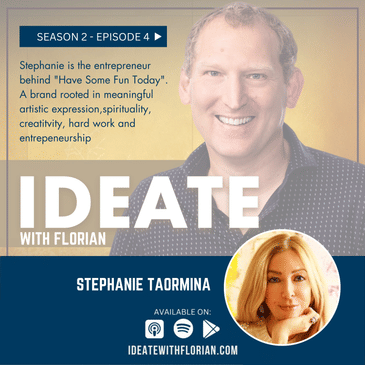
In this episode of the "Ideate with Florian" podcast, we feature Stephanie, the entrepreneur behind "Have Some Fun Today." Inspired by her father's uplifting mantra, Stephanie turned it into a positive lifestyle brand within six months. The brand, rooted in meaningful artistic expression, aims to connect people and impact lives. Stephanie talks about balancing being a do-er and visionary and how this attributes to a strong work ethic and artistic perspective. She emphasizes the importance of inner work and living a creative life. Despite initial outsider status, the brand gained recognition, especially in NYC, where Stephanie values the dynamic energy for growth. Stephanie's ultimate goal is to connect people and lives through the "Have Some Fun Today" concept and the power of art. Join us for an inspiring talk about spirituality, creatitvity, hard work and entrepeneurship!
Share:
Subscribe:
[00:00:00] Hello dreamers, thinkers and doers, welcome to Ideate with Florian.
[00:00:10] In this season we discover where good ideas come from, whether it's for a new feature,
[00:00:14] product or company.
[00:00:16] I'm your host Florian Hoornaar.
[00:00:18] For over 25 years I work with small and medium sized companies in engineering, sales and
[00:00:23] management.
[00:00:24] During that time I connected with many professionals to grow together.
[00:00:28] That makes me excited to explore the journeys of our guests with you, so let's dive in.
[00:00:33] Episode 4 Have some fun today with Stefanie Taormina
[00:00:38] In this episode of the Ideate with Florian podcast we feature Stefanie Taormina.
[00:00:43] The entrepreneur behind Have some fun today.
[00:00:46] Inspired by her father's uplifting mantra, Stefanie turned this phrase into a positive
[00:00:50] lifestyle brand.
[00:00:52] The brand is rooted in meaningful artistic expression and aims to connect people and
[00:00:57] impact lives.
[00:00:58] Stefanie talks about balancing being a doer and a visionary, and how this attributes
[00:01:03] to a strong work ethic and artistic perspective.
[00:01:06] She emphasizes the importance of inner work and living a creative life.
[00:01:11] Despite initial outsider status, the brand gained recognition, especially in New York
[00:01:16] City where Stefanie values the dynamic energy for growth.
[00:01:20] Stefanie's ultimate goal is to connect people and lives through the Have some fun
[00:01:23] today concept and the power of art.
[00:01:27] For an inspiring talk about spirituality, creativity, hard work and entrepreneurship.
[00:01:37] Stefanie, welcome to the podcast.
[00:01:39] Thank you so much Florian for having me.
[00:01:42] Thank you for being on the show.
[00:01:43] I'm honored.
[00:01:44] You are a true entrepreneur.
[00:01:46] You've had many businesses before and you are now the owner of the brand called
[00:01:51] Have some fun today.
[00:01:52] What kind of brand is it?
[00:01:54] Have some fun today is a positive affirmation lifestyle brand that uses fashion as its
[00:02:05] platform for sharing this positive message that I really believe the world needs to
[00:02:11] hear and to remember and to employ as often as they can.
[00:02:16] Right.
[00:02:17] So there's already a number of facets there and a few number of layers where you've
[00:02:20] got the positive affirmation that's basically what you want to carry.
[00:02:24] And then you used fashion as a platform to do that.
[00:02:27] And with an ultimate outing, I see a T-shirt behind you.
[00:02:30] There's a podcast, so it's audio only, but there's a T-shirt behind you.
[00:02:33] There's a cap on top of it.
[00:02:35] And that's your fashion brand.
[00:02:36] Yes.
[00:02:37] What kind of products are in that brand?
[00:02:39] We started with like a tote bag, a wristlet and some T-shirts, some sweatshirts,
[00:02:47] a coffee mug, you know, various things that people use in their daily,
[00:02:52] casual, everyday lives.
[00:02:54] And I immediately think about my mobile phone.
[00:02:57] Well, you know, we actually did start with a phone case.
[00:03:02] We stopped making them because we couldn't keep up with how often the
[00:03:05] phones were switching.
[00:03:06] And so we kind of said goodbye to that product.
[00:03:09] That's the reality of practical life.
[00:03:12] Yes.
[00:03:13] Yeah.
[00:03:13] Too many switches of the technology.
[00:03:15] I heard your story and I know where the phrase comes from.
[00:03:20] I'm not going to spoil it.
[00:03:21] I'm going to let you tell the story.
[00:03:23] Have some fun today.
[00:03:24] It's a slogan invented or made up by your dad.
[00:03:29] What's the story there?
[00:03:30] Somewhere, probably about 20 years ago, my dad just started using this phrase,
[00:03:38] have some fun today.
[00:03:40] And he would say it to every single person that he spoke to every day at
[00:03:46] the end of his conversation.
[00:03:47] So instead of saying goodbye, see you later, he'd look you right in the eye
[00:03:52] and he'd say have some fun today.
[00:03:55] And it was like this, you know, first it took people, you know,
[00:03:57] kind of off guard and they would kind of pause and say, oh, yeah,
[00:04:02] okay.
[00:04:03] And he just did it every single day for over 20 years.
[00:04:08] And so it was such an integral part of his personality when people thought
[00:04:13] of my dad, often they would think of this positive energy that he always
[00:04:18] carried at the company that he owned.
[00:04:21] It was the thing on their answering machine when someone called the business.
[00:04:27] It was on the punch cards when employees would check out.
[00:04:30] I mean, you know, clock out in the afternoon.
[00:04:34] He was so dedicated to sharing this phrase to everybody he talked to that
[00:04:42] it was like when he passed away and over a thousand people came to my dad's
[00:04:47] funeral, that was something that everybody kind of shared.
[00:04:52] And it was kind of going around our little town about my father and
[00:04:58] his positive energy and all the people he affected.
[00:05:02] And it was a couple months after my dad passed when I was doing a meditation in
[00:05:08] the morning and I had this vision of these words on a painting because I'm
[00:05:14] also an artist and I use words in my painting.
[00:05:18] And it just came to me that I was going to start a brand that shared
[00:05:23] this phrase on everything we do.
[00:05:26] And that was the beginning of the brand.
[00:05:27] I called my mom a few minutes after I had this vision.
[00:05:31] I mean, I saw the products in my head.
[00:05:34] I mean, it was a complete vision of something that I knew through my whole
[00:05:38] body that I had to do.
[00:05:40] How long does it take you to come up with a brand just in terms of order of
[00:05:45] making this like days, weeks, months, minutes?
[00:05:48] Well, in that morning when I had the vision of the brand and
[00:05:53] I actually had the vision of the initial pieces that I designed from
[00:05:58] that moment and letting my mother know because this was something that I felt
[00:06:03] was a legacy for my family, for my father.
[00:06:07] So I really wanted to share this wonderful idea with my mom.
[00:06:13] And after that she helped me out with an initial investment and
[00:06:19] I went up to Manhattan and I, because I went to school at Parsons School of
[00:06:23] Design.
[00:06:24] So that was my connection.
[00:06:26] I went right back there and I researched how I could get the different
[00:06:31] products made because there was a t-shirt, there was a handbag,
[00:06:36] there's a mug.
[00:06:38] There were all these different types of products.
[00:06:41] It wasn't like I had to go to one place to make these things.
[00:06:45] I found out that I had to deal with many different manufacturers.
[00:06:50] So by the time we got our first products and
[00:06:54] we uploaded them onto our first website, it was about six months.
[00:06:58] That's from ID to a website?
[00:07:01] Yes.
[00:07:02] But from like zero blank to the brand name and that vision of the painting?
[00:07:08] I got the impression that was like an instant.
[00:07:10] Yeah, I mean I knew in my head what I was going to do and
[00:07:15] that's kind of how I work as an artist and a designer.
[00:07:18] I don't know about you but I see it.
[00:07:21] I see the vision of it like whether I'm designing a room or
[00:07:24] I'm making a painting or I'm designing a handbag or a t-shirt,
[00:07:28] whatever.
[00:07:29] I see it in my head, I put it on paper and then I find out how to make it.
[00:07:34] And that's the process.
[00:07:35] The fascinating part for me is that I had a conversation and
[00:07:39] also a podcast interview with Patrick Williams.
[00:07:42] He is an artist from Omaha also in this season and he talks about
[00:07:47] you need to build a sort of a substrate of foundation as an artist.
[00:07:51] So you've got your room, you've got your pencils, you've got your easels
[00:07:55] but then you also have to prepare your mind so that when inspiration strikes
[00:07:58] you can immediately like acknowledge it and understand that it's there.
[00:08:02] And that's what I very much heard in your story as well
[00:08:05] because you've been an artist and working with materials
[00:08:08] and designs and ideas for a long time.
[00:08:11] Can you take us what your artistic story was?
[00:08:15] I think for me I resonate the most as an artist
[00:08:20] and have some fun today is purely an artistic expression.
[00:08:26] It's combining mediums, it's combining artistic ideology,
[00:08:32] almost poetry and spiritual messaging.
[00:08:35] And so that's one component.
[00:08:37] It is artistic in that it is like I actually put my art on my pieces
[00:08:43] as well as from a very technical design standpoint.
[00:08:48] We have to know how to make all these things
[00:08:51] and how to find the materials and all of that.
[00:08:53] So it's a very integrated process.
[00:08:56] So to go back as a young girl, I think Paper Dolls is really my first memory
[00:09:03] being like maybe like three.
[00:09:05] I believe the story is that I cut all my hair off using my Paper Doll scissors
[00:09:10] or at least part of it.
[00:09:11] My mother was very upset about that.
[00:09:13] Yeah, I can imagine.
[00:09:14] You know, I've always just been this really creative kid.
[00:09:18] You know, I saw crayons and I saw coloring books
[00:09:21] and wow, I could be lost for days.
[00:09:24] You know, as a young girl we had Barbies.
[00:09:27] We would take days to set up these elaborate houses
[00:09:31] using tissue boxes and improvising things around the house
[00:09:36] to make furniture.
[00:09:37] And these are all creative processes, you know, as little children.
[00:09:41] So, you know, always been an artist.
[00:09:44] You always took extra art classes, you know, throughout grade school,
[00:09:48] always won art awards.
[00:09:51] Art has always been something that just resides inside of me as a person.
[00:09:58] No matter what I am doing, I always go back to creating art.
[00:10:03] And how does an artist become an entrepreneur?
[00:10:06] First of all, my father, you know, when we was first born,
[00:10:11] he was a teacher, a Catholic school teacher and a coach.
[00:10:14] You know, so very low salary, really had to do side hustles.
[00:10:19] So my dad was side hustling, doing coaching,
[00:10:23] doing whatever he could to make extra money.
[00:10:25] So there is an entrepreneurial spirit in that my mother was a hairdresser
[00:10:31] and she ran her own hair salon out of our house growing up.
[00:10:35] So I was part of that.
[00:10:37] As a young kid, leading, you know, when your parents are leading by example,
[00:10:41] we're absorbing, you know, all that.
[00:10:43] So, you know, I grew up in a house where my dad is doing what he can
[00:10:47] to bring money home to support our family.
[00:10:50] My mother too had her own business and I would even have to like shampoo
[00:10:55] her clients, you know, like she needed help.
[00:10:58] We were the kids, we did what we had to do.
[00:11:00] We cleaned brushes and also my mother's mother, my grandmother,
[00:11:05] were very close to her and I actually named a handbag after her in my current line.
[00:11:10] And she was a real entrepreneur.
[00:11:14] She was really into real estate.
[00:11:16] She bought and sold antiques.
[00:11:18] She had a grocery store.
[00:11:21] I mean, that is just in my DNA.
[00:11:24] That's entrepreneurship right there.
[00:11:27] I mean, unhonestly, when I was 16 years old, I couldn't wait to work.
[00:11:32] So like as soon as I could get a job, I got a job and I was excited about it.
[00:11:38] You know, like it made me feel powerful.
[00:11:41] It made me feel like I was, you know, master of my own destiny kind of thing.
[00:11:46] So with that backstory of that entrepreneurial backstory,
[00:11:50] with that art backstory, I do want to go back to the really
[00:11:54] the starting of the painting of Have Some Fun Today.
[00:11:58] And what I find striking in the story is that you say you're doing your meditation
[00:12:02] or your spiritual moment.
[00:12:03] What how does that help in bringing that vision to you?
[00:12:08] Well, you know, some time I think I was always a spiritual person,
[00:12:12] but I don't think I really understood what that meant.
[00:12:15] And as I, you know, started to get a little bit older,
[00:12:19] I had my children in my thirties.
[00:12:22] You know, I was always kind of searching for answers.
[00:12:25] And like what I was really meant to do in my thirties,
[00:12:30] I think I was going through that a lot.
[00:12:32] And when I got into my forties, I changed my life a lot.
[00:12:37] I got divorced and I really delved into my own business as a designer.
[00:12:45] And along with that, I realized that we are very integrated as humans.
[00:12:52] And I really feel that, you know, our physical bodies and our physical energy
[00:12:58] is very tied to our emotional energy and also our intellectual evolution.
[00:13:06] And I believe very much in all of this
[00:13:08] needing to be integrated to have like this really good life.
[00:13:12] So I started, you know, I went to yoga seminars.
[00:13:17] I got really into yoga.
[00:13:19] I learned about meditation.
[00:13:22] I started integrating this stuff for a while.
[00:13:25] And then we had this experience with my father, you know, passing.
[00:13:30] And I had a rely on that kind of spiritual healing energy
[00:13:36] to kind of grieve my father and to sort of ask myself,
[00:13:41] what is next for me?
[00:13:43] And in doing that and taking that time in the morning to do a gratitude practice,
[00:13:49] you know, to think about the things that we're grateful for.
[00:13:52] Because I know when people do that, it really opens up more coming to us.
[00:13:57] We receive more abundance when we're showing gratitude
[00:14:02] and we're really, you know, acknowledging the things that are already abundant in our lives.
[00:14:08] So it just opens our minds and it opens our hearts to what else is possible.
[00:14:13] And that is when I found that I could see that I had
[00:14:17] I had an opportunity to do something with all the stuff
[00:14:22] I had been studying with spirituality, with living a good life,
[00:14:26] with health and wellness.
[00:14:29] And to me, all of those things are joyful.
[00:14:32] You know, when we can when we can master having those experiences
[00:14:37] and being aware of the beauty of them,
[00:14:40] that opens us up to this whole expression of have some fun today.
[00:14:44] We all have to work.
[00:14:46] We all have to do things that are hard.
[00:14:48] But if we can also appreciate the things that we do have,
[00:14:52] we can experience joy every day.
[00:14:55] Right. And that is really the essence of have some fun today.
[00:14:59] Can I imagine that you have that as a daily practice?
[00:15:02] Is it a daily credit to practice or is it a weekly how?
[00:15:06] No, it's daily.
[00:15:07] And, you know, I've also been in the past few months
[00:15:11] have also been adding on meditation at night before I go to sleep
[00:15:16] and also when I wake up in the morning.
[00:15:18] So a spiritual practice to me is very grounding.
[00:15:23] It's very grounding and it helps me shut out like the chatter,
[00:15:27] you know, because the world is very loud right now, very polarizing.
[00:15:33] And so I really believe in shutting out that noise
[00:15:39] and really feeling what what I need as a human.
[00:15:43] Doesn't it also help you or your creativity and what are the dice there?
[00:15:48] Yeah, absolutely.
[00:15:49] Because, you know, to design products for have some fun today
[00:15:54] that will lift somebody else's spirit.
[00:15:57] I have to really be very centered in my gratitude
[00:16:01] in the space that I can be to to create something
[00:16:05] that will resonate, will be useful,
[00:16:09] because I don't want to just make stuff.
[00:16:11] You know, that is there's enough stuff in the world, right?
[00:16:14] There there's more than enough stuff.
[00:16:16] And I would say that that is something that as a designer and a maker,
[00:16:21] I do struggle with that.
[00:16:23] It's like, oh, you know, I don't want to be one of those people
[00:16:26] who are who are just adding more stuff to the world.
[00:16:30] I do want to add meaningful.
[00:16:33] And so that's a little bit of a struggle, I would say, you know,
[00:16:37] making something that is useful and meaningful
[00:16:40] as opposed to just making something.
[00:16:42] You mentioned before that before the show started
[00:16:46] that you live in New York City and you live in a town called Waiomissing
[00:16:52] which is which is near Reading, Pennsylvania.
[00:16:55] I can imagine that New York City has a little bit more bustle
[00:17:00] and hustle than Waiomissing.
[00:17:03] And when you talk about centering and and coming back to yourself
[00:17:08] and shutting out the noise from outside,
[00:17:12] how is that different between those two cities?
[00:17:15] You know, it's actually amazing.
[00:17:17] I love to go to New York City
[00:17:20] to really be stimulated with the energy of the world
[00:17:25] because it's such a melting pot.
[00:17:28] I walk out the door and I am confronted with every single ethnicity,
[00:17:34] you know, gender, sexual identities.
[00:17:38] I mean, it's all there and to me it's all beautiful
[00:17:43] and it's very stimulating to me to be around
[00:17:48] all this worldly culture.
[00:17:51] So I love going there for those reasons.
[00:17:55] It's kind of awe inspiring, really, to be walking down a street
[00:18:00] and just to experience all the different facets of humanity.
[00:18:05] So I love being able to go there and get stimulated,
[00:18:10] go to amazing art shows, have wonderful food
[00:18:14] from all over the world to speak to people who,
[00:18:18] you know, are strangers.
[00:18:20] But like there's like a common humanness.
[00:18:22] And I experience like great beauty in the world when I'm in New York City.
[00:18:28] I mean, there's also a lot of things that are hard
[00:18:31] because you do see the harshness of the world.
[00:18:34] But I think that that too has a place in what I take in as an artist
[00:18:40] because it's life, right?
[00:18:41] There's good and bad.
[00:18:43] Sure. You can have blinders on.
[00:18:45] You really have to have an awareness of what's really happening
[00:18:49] and to also have compassion and empathy for where we can do better as people.
[00:18:55] And to see all parts of life and not pick and choose
[00:18:59] whatever you think fits best in your worldview.
[00:19:02] Yeah, you know, and then living in why I'm missing part of the time,
[00:19:05] which is where I have my art studio.
[00:19:07] And that's the other part of the cycle, I guess, right?
[00:19:09] Yeah. And that's where I can employ working, doing the work, you know,
[00:19:16] doing the paintings that lead to inspiration for the brand.
[00:19:20] You know, here in the in why missing, it's very beautiful.
[00:19:24] You know, it's green, lush grass and trees and old trees
[00:19:29] and very quiet streets and not a lot going on.
[00:19:33] So it's such a contrast.
[00:19:35] So for me, the two worlds are very essential to who I am as an artist.
[00:19:41] How do you how do you see the difference of setting up a fashion brand
[00:19:46] from why missing versus New York City?
[00:19:49] Because you first, you were just in why you're missing.
[00:19:51] And now you're also New York City and Los Angeles.
[00:19:54] How has that changed?
[00:19:56] Well, it's interesting because we just got this place in New York in April.
[00:20:01] So it hasn't been that long.
[00:20:02] And running the brand from why I'm missing, I mean,
[00:20:07] I would go to New York City all the time.
[00:20:09] Both of my daughters live there.
[00:20:11] And so I've been taking them there since they were three years old.
[00:20:16] I mean, I love New York.
[00:20:17] I feel like New York is where I live, you know, in many ways.
[00:20:22] I feel very New York.
[00:20:24] So really for the first nine years of the brand being based out of why I'm missing,
[00:20:29] you know, I kind of liked it.
[00:20:31] I am not a follower.
[00:20:33] I am a disruptor and I love that I was this outsider, you know, doing this thing.
[00:20:43] I mean, celebrities were wearing are wearing our brand like me.
[00:20:48] The cooness of video is going viral wearing this hoodie.
[00:20:52] And it was, you know, me doing this in little why I'm missing Pennsylvania.
[00:20:56] So I like the way it started.
[00:20:58] So I'm all good with that.
[00:21:00] Now that I'm also in New York, it is changing the brand because I'm just having
[00:21:06] coffee with people and they're like, how can I help you?
[00:21:10] So I do believe that if you want a business, especially in fashion or art,
[00:21:17] you do have to have some proximity to a place where it's really happening
[00:21:23] in terms of growing the brand from within the brand.
[00:21:27] But, you know, the idea of being here and designing the brand and working it,
[00:21:33] I think it was it made it more unique.
[00:21:36] You know, it gave it a different a different edge and I like it.
[00:21:48] The future of work is flexible.
[00:21:51] If you are being mandated to return to the office fear not.
[00:21:57] There are things that you can do to create flexibility for yourself.
[00:22:01] And there are things that you can do to prepare for the inevitable
[00:22:05] flexibility that is coming your way.
[00:22:08] Collaboration Superpowers helps people and companies work better together
[00:22:12] from anywhere, and we've got a free remote working success kit to get you started
[00:22:18] from personal user manuals to team agreements, virtual icebreakers
[00:22:23] and more.
[00:22:24] Download the remote working success kit at collaboration superpowers.com.
[00:22:30] We'll see you online.
[00:22:33] I'm going to make a little crossover between two shows.
[00:22:36] There's another show called Collaboration Superpowers,
[00:22:40] which is hosted by my wife, Lisette Södeland.
[00:22:42] And that show is all about working remote, remote collaboration,
[00:22:46] remote teams doing great things.
[00:22:48] And here you're saying like, no, you really need to be you need to be
[00:22:52] in your case in New York and have coffee with people in person.
[00:22:56] Why doesn't the Zoom call do the trick?
[00:22:59] I would almost ask, you know, I think there is something about being
[00:23:04] in the city and someone saying, let's meet for coffee.
[00:23:09] It's different than if you're going to schedule a Zoom call.
[00:23:13] I think that you can do a lot of great things with Zoom calls.
[00:23:17] Don't get me wrong.
[00:23:19] For example, we just had a meeting yesterday on a Zoom call with one
[00:23:25] of the women who does all the events at Soho House in Miami
[00:23:30] because we are planning something for our basketball.
[00:23:33] We've got a scoop here.
[00:23:34] Yeah, we have a really cool scoop here.
[00:23:37] And that was amazing that I could have this meeting with this woman
[00:23:41] who I've never met before and we can start to make something happen.
[00:23:45] You know, Miami to PA.
[00:23:48] But when you are living in a city and you can impromptu schedule
[00:23:54] that coffee or have that drink or have lunch, there is a I think
[00:24:00] people want to help you.
[00:24:01] You know, you'll be talking about personal stuff, but then
[00:24:04] there'll be that point where they say, well, tell me about what
[00:24:06] you're doing.
[00:24:07] And then they want to sit on the table with you.
[00:24:09] Yeah, they want to offer something if they think that
[00:24:12] they can.
[00:24:13] Yeah.
[00:24:13] And I have found that every single time I have met with
[00:24:17] someone in New York, I have walked away with them offering me
[00:24:21] some way to help me.
[00:24:22] And I haven't had that as much doing Zoom calls and living here
[00:24:28] and why missing only it's taking longer to do what I need to do.
[00:24:34] So the New York City move is OK.
[00:24:37] For me, I believe that time is of the essence.
[00:24:40] But this is a perspective.
[00:24:42] Why are you missing the New York City?
[00:24:43] That's about a three hour drive.
[00:24:45] It's about a two and a half hour drive.
[00:24:47] So it's not the end of the world.
[00:24:48] You could just I'll see you in the afternoon, right?
[00:24:51] That's that's how it could be.
[00:24:52] I could easily do that.
[00:24:53] Yeah.
[00:24:54] And yet it's different.
[00:24:56] It is because I just have found like trying to nurture certain
[00:25:00] relationships with people who are in New York who could help me.
[00:25:03] It's just taking longer because it's like, oh, when I come back,
[00:25:06] we'll do that, you know?
[00:25:07] And so it just changes the dynamics.
[00:25:10] So another dynamic that I want to talk about and thank you for
[00:25:13] for using that word and I can make a segue out of it is that the concept
[00:25:17] of on one hand, you got visionaries who come up with the groundbreaking ideas.
[00:25:22] And on the other hand, you got integrators who make those ideas a reality.
[00:25:27] Hearing your story, I have to feel that there's a little bit of both in you.
[00:25:31] Yeah, definitely.
[00:25:33] How did you balance that or melted together or keep that apart?
[00:25:38] Or how can you be a visionary value also just doing the stuff needs to be done?
[00:25:43] Yeah, I hear you next year.
[00:25:46] Well, I mean, it's a it's a I've never had that question asked to me before,
[00:25:50] but it's a really great question, Florian, because I kind of go back to high school.
[00:25:56] I was like that student that really studied really hard.
[00:26:01] I don't know.
[00:26:01] Maybe I was like super geeky.
[00:26:03] I don't know.
[00:26:04] But I would come home from school or from practice
[00:26:07] because I also did like every sport you and every activity you could do.
[00:26:11] You know, I was that kid, but I had a study really hard.
[00:26:15] It just I couldn't go into a test and not prepare for it.
[00:26:19] I wasn't one of those kids who could ace a test without trying.
[00:26:23] I had to try really hard.
[00:26:25] So I think that it became habitual to me to really know what I was going to do,
[00:26:36] like study for the test, work hard on the paper, the research paper.
[00:26:41] I never winged anything.
[00:26:44] I don't really wing things like now, maybe after doing this brand for nine years
[00:26:52] and having been an artist and a designer my whole life, I can wing a conversation about.
[00:27:01] But so so I was that person who was very Taipei, you know, so that's the doer.
[00:27:08] I got to get this done.
[00:27:09] I know how to do it being the the person who dreams up the idea and has the creative
[00:27:17] freedom in my head.
[00:27:18] I think that comes from being an artist also.
[00:27:23] Yeah.
[00:27:24] And, you know, right now and for many years, my main style of art is abstract expressionism.
[00:27:34] So I think to be an abstract expressionist, you have to have a very bold and free
[00:27:44] and a lot of confidence in what you're going to put on the canvas.
[00:27:49] And I have that.
[00:27:50] And how do you do that at the same time?
[00:27:53] How can you be like that type a doer with a busy head and all the other
[00:27:59] hand, do that free expression?
[00:28:03] Well, I think that's where the spiritual practice comes to play because I do a lot
[00:28:08] of inner work.
[00:28:10] I have done a lot of inner work for roughly 20 years.
[00:28:15] I mean, it's not a new thing.
[00:28:17] I somehow I think in my my personal struggles in my 30s, I think I realized
[00:28:26] that I needed to do something and I needed to figure some things out.
[00:28:31] And so I think that was really something that I learned to do out of like survival
[00:28:38] in my head.
[00:28:38] And so I think it's the spiritual practice that I've cultivated over a long
[00:28:44] period of time and experimenting with different types of spirituality and
[00:28:49] meditation and, you know, different types of practices that we all have learned about.
[00:28:55] I think that has given me this permission to explore the the concepts that come
[00:29:03] into my head visually with confidence and experience knowing what this process entails.
[00:29:11] That word permission is a very interesting word in the creative process.
[00:29:16] Do you give yourself permission to be free, liberated from,
[00:29:20] untatted from the rest of the world and just in your own mind and
[00:29:23] expressing yourself boldly?
[00:29:25] I guess. Speaking of creativity,
[00:29:28] have you heard about Rick Rubin's new book called The Creative Act?
[00:29:33] No, I have not. No.
[00:29:35] Rick Rubin, he's just a profound personality.
[00:29:39] He's like one of the greatest living music producers in the world.
[00:29:45] He's the co-founder of Def Jam Records and I'm a huge fan of his.
[00:29:51] And he recently released this book and it's almost like a Bible on creativity.
[00:29:56] Earlier in the fall, I started reading The Artist's Way because as a founder
[00:30:02] and a creative director, I want to take in all of these different
[00:30:08] philosophies that will help the act of creation in my own life and understanding,
[00:30:16] how we process our inspiration and what we do with our inspiration.
[00:30:22] So being free in creative expression,
[00:30:28] artistically is the end all.
[00:30:31] And so I work very hard in having that freedom and having that confidence
[00:30:37] to put things down on paper and explore the significance of that.
[00:30:41] That makes a lot of sense.
[00:30:42] And again, it's that years and perhaps decades of preparation because you can't say,
[00:30:49] hey, I'm going to wake up and let's be creative now and let's invent a new product.
[00:30:54] You know, there is sometimes if this scenario here is that you go to the office
[00:31:00] and your manager says, hey, I want you to come up with a new widget and I need it
[00:31:04] before tomorrow, how does creativity work in this scenario?
[00:31:09] How do you reflect on that?
[00:31:11] Yeah, I mean, creativity is a way of being.
[00:31:15] It's it's how I it's how I breathe.
[00:31:19] It's how I wake up.
[00:31:20] It's how I get dressed.
[00:31:22] It's how I exercise.
[00:31:24] It's how I eat.
[00:31:25] It's how I think.
[00:31:26] It's how I speak.
[00:31:27] It's what I read.
[00:31:28] I want to read about other ways of being creative.
[00:31:31] I want to implement rules on how I'm going to do a project just for the
[00:31:37] creativity. Those rules will create in my work.
[00:31:42] It's it's everything.
[00:31:43] It's how I set up my house.
[00:31:45] It's the trip site.
[00:31:47] Right.
[00:31:47] It's the restaurant I go to.
[00:31:49] It's the movie I watch.
[00:31:51] It's a way of living your life.
[00:31:53] When I look at the hoodie that is behind you in a different font than the cap
[00:31:59] that's on top of that.
[00:32:00] So there's a different style there.
[00:32:03] How does the process work?
[00:32:05] Do you have like a brainstorm with your team and says, Hey, what kind of
[00:32:09] problem do we need? And they say, hoodie.
[00:32:11] And then you go off three days on the retreat and come back with a design or
[00:32:16] what's the process there?
[00:32:18] The process for me has been that I start thinking about something.
[00:32:23] Some idea will come into my head and it'll just kind of percolate there.
[00:32:28] And I won't talk about it.
[00:32:30] I'll just see it along with a million other things that are happening in my life.
[00:32:34] And it'll stay there and it'll kind of get little flashes of development.
[00:32:41] Literally, as almost as if I have a computer program running in my head
[00:32:46] and I have the tab open.
[00:32:48] OK, so let's say I'm thinking about a new affirmation
[00:32:53] or graphic that I need to do, which is clearly it's actually something I need to do.
[00:32:58] So I know what I want to do because I've already decided intellectually.
[00:33:03] Oh, this is what we have to do next.
[00:33:05] So that's been decided on knowing I have to do it, knowing it makes sense
[00:33:10] in the in the pipeline of what we're doing.
[00:33:13] Then I'll start to think about it.
[00:33:14] It'll be there. It'll sit there.
[00:33:16] I'll get little flashes and because I have so many other things running
[00:33:21] and I don't have a design staff, it's literally me.
[00:33:26] I definitely speak with my younger
[00:33:29] daughters who are in their 20s and live in Manhattan.
[00:33:32] And, you know, they have definitely been influential in my design because I love young.
[00:33:38] I love the youthful mind.
[00:33:41] I really appreciate really all minds.
[00:33:44] I appreciate what my mom and older people than my mother think.
[00:33:48] I appreciate things that my contemporaries are thinking.
[00:33:52] I'm very interested in culture.
[00:33:55] I think that's why I love being in New York.
[00:33:57] I love being here.
[00:33:58] I love looking at social media.
[00:34:01] I my mind, my computer chip in my head is seeing as much as I can see.
[00:34:08] And all the while this design is running in my subconscious.
[00:34:13] The design is happening.
[00:34:14] At some point, I will realize that now it's time to put this on paper.
[00:34:20] And that is really the hardest part for me because I'll know I have to do
[00:34:25] something I'm designing it in my head.
[00:34:27] I'm not speaking about it.
[00:34:29] There's no conversation about it.
[00:34:31] And then one day I sit down and I knock it out.
[00:34:34] And I do that every single time with every product I design.
[00:34:38] And every single time it's immediately it's done right or?
[00:34:42] Oh, yeah. Yeah. I get down there.
[00:34:44] I sketch it out.
[00:34:45] I send it to my factory and I say this is the design.
[00:34:49] And then he comes back.
[00:34:51] He comes back with a sample.
[00:34:53] I'll either love it as is or I'll make some tweaks.
[00:34:57] But that's the process.
[00:34:58] That's amazing.
[00:34:59] That's so again, there's a long time of preparation and then like Ka-Blamo.
[00:35:04] That's that's the moment where you put it on.
[00:35:07] Yeah. The moment you put it on paper, is that stick the get up in the morning?
[00:35:11] Do you credit your practice and then 9 a.m.
[00:35:14] You go to your studio or is it midnight at night?
[00:35:16] Any time can happen or do you schedule that in your calendar or how does that work?
[00:35:21] Sometimes I write it on my calendar due designs today.
[00:35:28] I don't know why it's like I have to like push.
[00:35:31] It's like a part of me has to push myself to sit down and do sketch.
[00:35:36] I guess I don't know why I don't know why.
[00:35:39] And then and I'll get it down be like, oh, thank God, you know, I just finally did it.
[00:35:43] It's like I'm procrastinating in my subconscious.
[00:35:47] You know, yeah, it's kind of funny.
[00:35:49] And I have a bunch of stuff currently that that's happening.
[00:35:53] Like I'm I'm designing an affirmation art piece of art in my head.
[00:35:57] But and I know I know the theme.
[00:36:01] I know the colors.
[00:36:03] I have the ideation, but I need just to get down there and do it.
[00:36:07] My background is in software development.
[00:36:10] And the fun thing with software is that you can just toss out the version in the
[00:36:14] open, even if it's crappy, because next week you can have a new version
[00:36:19] which has improved and better.
[00:36:21] You know, and it can still be a bit crappy, but it's OK because the week after that
[00:36:24] you just you overwrite it with a new version, right?
[00:36:27] Uh-huh.
[00:36:28] Your t-shirts and hoodies and caps and tote bags and coffee mugs.
[00:36:34] That's harder to do.
[00:36:36] You can't just toss something out in a week later.
[00:36:38] I think this is I got a better idea.
[00:36:40] You just recall all your merchandise and products and everything and re-ship
[00:36:46] that new.
[00:36:47] Yeah, you can't do that.
[00:36:49] Physically impossible.
[00:36:51] They have created a certain level of stress because they're
[00:36:54] only give stress with software developers who are very hesitant of shipping their
[00:37:00] product. How do you deal with that?
[00:37:02] You know, I think the most important thing when you're designing products is
[00:37:08] to really have a lot of trust in your manufacturer.
[00:37:13] So I think the fact that I have a lot of trust
[00:37:18] in the people I'm working with that if there is, you know, I know that they're
[00:37:25] going to make my product in a very high quality way.
[00:37:32] I have had bad experiences working with factories who have ruined my designs
[00:37:39] at times and, you know, I've had those experiences and luckily most of the time
[00:37:46] they make it right.
[00:37:48] So so you have to system set up in the way that you wanted to be set up quality wise.
[00:37:54] Now, you work with the factories who can do what your vision is and you are no
[00:37:59] longer working with the factories who have the lower quality.
[00:38:02] Yes. Yes.
[00:38:03] And you have the vision.
[00:38:05] You give it to them.
[00:38:06] It's almost like you put it on a conveyor belt or your product and it goes
[00:38:09] to the next station, next station.
[00:38:11] But the moment that's on the conveyor belt,
[00:38:13] you can trust the system that you build.
[00:38:16] Yeah, I mean, that is that is the goal.
[00:38:20] And it takes sometimes it takes time.
[00:38:22] Sometimes you work with people who don't do that.
[00:38:24] And that's right.
[00:38:26] You have to learn the hard way, unfortunately.
[00:38:28] And I know I've had many things over the nine years because,
[00:38:32] you know, it wasn't like I came from a brand background already.
[00:38:37] I was I was an interior designer who decided to go back into fashion for a very
[00:38:44] specific reason that was greater than than not doing it.
[00:38:51] And I made mistakes, you know, I made mistakes.
[00:38:55] I did the best I could.
[00:38:57] I was very honest with people when a mistake was made.
[00:39:01] And that's all you can be.
[00:39:03] And you just have to be accountable.
[00:39:06] And, you know, for any customers who experienced a product of mine that was,
[00:39:12] you know, lesser than it should have been, I did whatever I could to make it right.
[00:39:17] And that's all you can do and learn from your mistakes and try to work with
[00:39:22] people who really are quality and give you what you ask for and give you what
[00:39:28] you pay for the team that you have around you is very close to you,
[00:39:32] I believe, right?
[00:39:33] Yes. My partner, Jay Schwaid, has is really has been amazing and has helped me
[00:39:41] navigate growing this business incredibly just in a year and a half.
[00:39:47] We have upgraded every system that we have with marketing and fulfillment
[00:39:54] and production and budgeting and finance.
[00:39:58] So we have we have grown a lot in the past year.
[00:40:02] Thanks to working with someone who is really dedicated to making this a worldwide success.
[00:40:10] It's just an amazing story about art.
[00:40:12] It's an amazing story about entrepreneurship, about where you came from.
[00:40:16] You know, the artistic drawing and playing with dolls and cutting off your own hair
[00:40:22] when you were a child all the way to your the way that you express yourself
[00:40:26] through art now, it's so amazing.
[00:40:28] There's this one last topic that I want to touch on and that is an entrepreneurial
[00:40:32] topic, and that's about the economics of the kind of business that you run.
[00:40:36] Because you mentioned that she was the interior design.
[00:40:39] And the way that I'm used to that how it works is that you you get a client,
[00:40:45] you do work for them, you send an invoice two weeks later, you get paid.
[00:40:49] How does this kind of world work?
[00:40:53] Not talking about figures, but just in general, what's the concept here?
[00:40:56] Yeah, well, it's very different structure.
[00:40:59] Being an interior designer was a great.
[00:41:03] I loved doing that and I love the structure.
[00:41:06] It was great.
[00:41:07] I didn't have to put so much out personally.
[00:41:10] When you're manufacturing, it's 100 percent different.
[00:41:14] We have to pay for everything up front.
[00:41:17] So, you know, for a clothing brand or for our lifestyle brand, because we make
[00:41:21] bags, we make clothing, we make hats, we make a lot of stuff.
[00:41:25] And to make any one thing, you have to make a minimum.
[00:41:29] So it's not like I'm going to make 10 handbags, you know, I need to make 300.
[00:41:36] Sometimes you have to make a thousand.
[00:41:38] And so you have to pay for that.
[00:41:40] And then you have to market that, which costs a fortune.
[00:41:46] And then you have to wait for people to buy it on your website or wherever they
[00:41:51] shop. So it's a very different structure.
[00:41:53] It's definitely a longer game.
[00:41:56] But it's what I believe in, and it's what I'm not doing this to make the kind
[00:42:04] of money liquid that I made when I was a designer.
[00:42:07] I'm doing this for a much deeper meaning.
[00:42:10] So I'm willing to sacrifice what I have to to do this.
[00:42:16] I think that brings the story nicely full circle back to the vision and mission
[00:42:21] that you have of have some fun today enriching people's lives.
[00:42:26] Yeah, so that is what our goal is to do.
[00:42:30] We want to expand the brand.
[00:42:32] I mean, the concept have some fun today
[00:42:36] that could reach people's lives in so many ways.
[00:42:40] I don't think we've even really begun to tap all the ways that that could
[00:42:45] be meaningful for people.
[00:42:48] And one other thing that we also hope with our success,
[00:42:54] our continued success is to do some really special inspirational charity
[00:42:59] projects that involve fashion, art and charity and fun.
[00:43:06] I think they are some wonderful parts of humanity.
[00:43:12] And we are working on a special project called the Elsie project,
[00:43:17] which we did one in New York City in June, where we shared one of my designs
[00:43:24] with a group of artists and they each took a handbag.
[00:43:27] It was an Elsie bag and they used it as their canvas to create a work of art.
[00:43:32] And then we had a big event where people could come bid on these handbags
[00:43:39] and then we donated 100 percent of the proceeds to a charity.
[00:43:44] And so we see activations as part of our brand as a way to connect people,
[00:43:52] to connect the celebration of art with the the impact that fashion can have.
[00:44:00] And all the ways that we can make the world a better place
[00:44:04] through so many charities that exist in the world.
[00:44:07] And so we are hoping to partner with Soho House and do our next one at Art
[00:44:11] Basel, Miami and then hopefully to go on from there and do them at all the Soho
[00:44:17] houses in the world.
[00:44:19] So that is kind of the vision I have to use fashion as a platform for helping
[00:44:26] other people and spreading joy.
[00:44:29] It's an amazing story.
[00:44:30] I'm so happy that I had an opportunity to talk with you.
[00:44:33] Thank you very much for being on the show.
[00:44:37] I will put links to your website, to your LinkedIn,
[00:44:41] to wherever you want people to go into the show notes.
[00:44:44] And if you have any follow up questions, just feel free to ask them there.
[00:44:48] Stephanie, thank you very much.
[00:44:50] Thank you, Florian.
[00:44:51] It was so lovely meeting you and talking with you.
[00:44:54] Have some fun today.
[00:44:57] And there you have it, another inspiring episode of the ID8 with Florian podcast.
[00:45:02] As always, I encourage you to visit our website at ide8 with Florian.com.
[00:45:07] That is ID8 with Florian.com.
[00:45:11] Here you will find links related to this episode as well as other episodes.
[00:45:15] My name is Florian Horna and I hope the story inspired you.
[00:45:19] Thank you for joining me and until next time.