
BIO
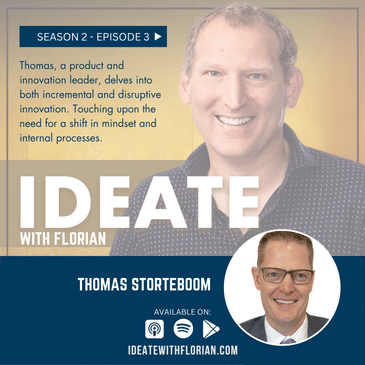
Thomas Storteboom is a product and innovation leader with over 24 years of experience in the automotive and supply chain industries. As CEO of i2e Solutions, he guides companies in aligning their product and innovation strategies for growth. Thomas, with a track record at CHEP and Cox Automotive, excels in optimizing development processes, launching successful products, and presenting to investors. Holding an MBA and MS in Engineering from the University of Michigan-Dearborn, Thomas is passionate about helping companies realize their innovation potential and shape the future of the automotive and supply chain sectors.
SHOW NOTES
In this episode of the "Ideate with Florian" podcast, we're excited to feature Thomas, a professional with a background in a major global corporation. Thomas shares his insights into driving innovation within companies, drawing from his vast experience. Explore the challenges and dynamics of innovation, from who is responsible for the innovation within companies to cross-functional dynamics. Thomas delves into both incremental and disruptive innovation, shedding light on why incremental innovation is most likely. Thomas discusses the cultural aspects of fostering innovation within an organization, touching upon the need for a shift in mindset and internal processes. Join us for a thought-provoking conversation with Thomas on innovation, corporate culture, and the intricacies of bringing groundbreaking ideas to life.
Share:
Subscribe:
[00:00:00] Hallo Dreamers, thinkers en duizenden, welkom bij Ideate Florian. In dit moment we discovererden
[00:00:11] were good ideas komp from, wether het is voor een nieuwe feature product of company.
[00:00:16] Ik ben jouw hout Florian Hoornaar, voor over 25 jaar werk ik met kleine en medium-sized
[00:00:21] companies in engineering, sales en management.
[00:00:24] Durant de tijd, ik ben net met veel professionele zoveel te groen. Dat makes me
[00:00:28] om te gebruiken in de gegeven momenten met jouw, dus laten we het gaan.
[00:00:32] Episode 3
[00:00:35] Incremental ideas maken geld met Thomas Sotterong.
[00:00:38] In dit episode van de Ideate Florian podcast, we hebben er een proficial
[00:00:45] met een beest van een grote verantwoordige cooperatie.
[00:00:48] Deze vanaf de verantwoord, Thomas scherpt zijn in de
[00:00:52] de drijfing innovatie met in de kompans. We hebben het geleden en de
[00:00:56] energiën van de innovatie van de responsuele voor de innovatie met in de
[00:01:00] kompans, om de grootte, functieel en de dynamische. Thomas
[00:01:03] derde het in het both incremental en disruptief innovatie.
[00:01:06] Schelling Light on Why Incremental Innovation is most
[00:01:10] likely to yield success. Thomas discusses de
[00:01:12] culturel aspect van de volstrengen innovatie met een organisatie,
[00:01:16] totgengen op de need voor een shift in mindset en
[00:01:19] en interne processus.
[00:01:21] Voor het gevoelige conversatie van Thomas,
[00:01:24] een innovatie kooprote culture
[00:01:26] en de interkezies van te brengen
[00:01:28] om grondbrengen de idea te leven.
[00:01:34] Thomas, welkom, welkom te te zien.
[00:01:36] Thanks for it, it's great to be here.
[00:01:38] Today we're going to talk about innovation.
[00:01:40] Typically my background is more in smaller companies
[00:01:43] en startups,
[00:01:44] en dat is niet voor jouw expertise.
[00:01:47] Voor het gevoelige conversatie van Thomas,
[00:01:49] en mijn background is voor het gevoelige conversatie.
[00:01:51] En ik was in een woonbeord van de wereld.
[00:01:53] De meeste wereld werd gevoerd.
[00:01:55] De meeste wereld werd gevoerd om 35 jaar.
[00:01:57] Ik goudt op de behoorde gevoerd in een city called Dearborn,
[00:02:00] en dat was voor het gevoerd.
[00:02:02] Ik goudt op een behoorde historische home.
[00:02:04] Het was een deelde historische home
[00:02:06] en het gevoerd was de huis in 1920.
[00:02:09] Ik ging naar het Zuid-Hijschool.
[00:02:10] Our mascot was de Thunderbird.
[00:02:12] En ik kon een historische klasse,
[00:02:14] en die was in de prototype van de design.
[00:02:16] Dat was een heel groot meegekeven van de gevoerd.
[00:02:18] Ik had 10 jaar geleden gevoerd.
[00:02:20] Ik lovde er een minuut over.
[00:02:22] Maar dat was waar ik op de behoorde gevoerd in verbanding in corporate-america.
[00:02:25] Dat was een vaste, multiteindelijk beelden door de beelden van de Wereld.
[00:02:28] Dat was een verbeelden door de beelden van de beelden van de wereld.
[00:02:30] Dat was een verbeelden door de beelden van de beelden van de beelden van de beelden van de beelden.
[00:02:32] Dat was een verbeelde gevoerd.
[00:02:34] En ook innovatief.
[00:02:36] Ik denk dat we allebei en de zonbelen in het jaar
[00:02:40] is als een mascot van de innovation.
[00:02:42] We hebben een hele mooie verhaal.
[00:02:44] Ik ben heel erg eager om te zien op deze moment waar we het innovatie en we
[00:02:49] het ideatie en we starten nieuwe rekenkomen, want ik wil hier,
[00:02:55] uit te zien en dit is de verhaal, we kunnen hebben.
[00:02:57] Ik hoop dat we de oportunities voor de kleine kopen hebben.
[00:03:01] Hoe doen we de laagdekoppers innovatie?
[00:03:04] Hoe doen we het, wat we de trektjes voor het trait, wat zijn we goed dat en
[00:03:08] En misschien ook, waarom hoogt de bal en versie een oportuniteit voor smaller company?
[00:03:14] Dus kan je het begin van de stichtpaintepictuur?
[00:03:17] Like in everyday, vooral of wat je doet met een company?
[00:03:21] Ik help company's find better ideas in het leven.
[00:03:25] Ik ben inderpen in consultant.
[00:03:27] Ik werk met company's dat er stuggen om te groen door de innovation.
[00:03:30] Dat er gewoon bad idea zijn dat er in de market in is.
[00:03:34] en ze zijn er stuggevallen om de ideeën door hun procesen te maken en te te maken om te maken.
[00:03:39] Ik helpen de deuren die bestekken, maar het is een goed ideeën.
[00:03:43] En dan te leren van de zateringen dat de consumers en de deuren die er in zijn leven zijn.
[00:03:48] Dat is mijn sweet spot.
[00:03:49] Ik werk in innovatie en strategie.
[00:03:52] Ik help met brainstorming, ik doe een innovatie en training.
[00:03:55] Dat is de meeneere is dat ik dit geeft.
[00:03:58] Wat organisatie is die we typisch consult met?
[00:04:01] Dat is een hele grote company, het is best leuk, omdat de meeste in de
[00:04:04] meer dan een milie in de dollar is, maar nu focus ik op
[00:04:07] de mooie company, ik heb dat geval om het te helpen, ik kan er
[00:04:12] heel veel valueren.
[00:04:13] Het is een ruimte, veel mensen die niet hebben de expertise
[00:04:16] dat een van de deel van de andere company hebben.
[00:04:17] Dus ik denk dat ik over 20 jaar in Corpor America en
[00:04:21] de kleine company van de kleine ingeving heb.
[00:04:23] Wat kinderorganisation is dat?
[00:04:25] We hebben het gezet dat ten mensen in een company honderd
[00:04:28] wat een kleine jeugd is.
[00:04:29] Ja, het is honderd.
[00:04:30] Dus het is 10-100, het is niet 1000, het is 10-1000.
[00:04:35] Het is 10-10 mensen, 200 mensen.
[00:04:38] Some of them don't even have an innovation group or a product group.
[00:04:41] Some of them do that they just need some help
[00:04:44] or some guidance, or some extra strategy.
[00:04:46] Usually sweet spots, let's call it 10-100 million dollar in revenue.
[00:04:51] We can go larger but that's kind of the sweet spot.
[00:04:54] OK.
[00:04:55] So in this smaller company, typically I mean,
[00:04:57] I really talk about the startup here.
[00:04:59] You meet and speak to the CEO, the chief product officer,
[00:05:03] the CTO, the founders at least.
[00:05:06] So in my mind, bigger companies, you call them smaller.
[00:05:10] We're talking about tens of people, hundreds of people.
[00:05:13] It's relative, it's all relative, right?
[00:05:15] Yeah, it's all relative, it's a matter of perspective.
[00:05:17] So in those companies who have grown out of this startup phase,
[00:05:21] who's responsible for innovation there?
[00:05:24] So for me, it all starts with the president or the CEO.
[00:05:28] It's the same people.
[00:05:29] Right, because if the president or the CEO isn't behind it,
[00:05:31] it's not going to happen.
[00:05:32] And here's the reason for it.
[00:05:34] And this is what I've learned in big companies.
[00:05:36] Is innovation is an all-skate and everybody has to participate.
[00:05:40] It's not an option.
[00:05:41] So we can't put innovation in one group
[00:05:44] and hope the company's going to be innovative.
[00:05:46] The whole company needs to be innovative.
[00:05:48] And so when we're looking at evaluating and developing
[00:05:51] and bringing ideas to life, everybody's going to be involved.
[00:05:53] Sales, marketing, finance, manufacturing, operations.
[00:05:57] They all need to be a part of it.
[00:05:58] So if that president is not focused or the CEO is not focused
[00:06:02] on being innovative, the company's not going to follow.
[00:06:05] And you can't put innovation in one group
[00:06:07] and hope that it gets through when you get something new out of it
[00:06:10] because that's just not the way it works.
[00:06:12] It's everybody has to play together.
[00:06:14] Everybody has to come together to get the idea done.
[00:06:17] And they need to be along for the journey.
[00:06:18] They need to be along that whole process.
[00:06:21] Now they have different roles to play in different amounts of time.
[00:06:23] But if they're not involved in the whole process, it breaks down.
[00:06:26] And I see that time and time again.
[00:06:28] So to me, innovation starts at the top.
[00:06:30] So there's another finance team and an HR team
[00:06:32] and a product delivery team and an innovation team
[00:06:35] that's not how it works.
[00:06:37] Yeah, there's a team that can lead innovation.
[00:06:39] But if I come in and they tell me, there's the innovation team
[00:06:42] but they don't interact with anybody
[00:06:43] and they're not bringing in the finance team
[00:06:45] and they're not bringing in accounting or sales
[00:06:47] or marketing or operations, then that's the problem.
[00:06:50] You can have somebody who's in charge of it and leading it
[00:06:53] but if they're not working cross functionally, it will break down.
[00:06:56] I guess that's the same in a really small company as well.
[00:06:59] It's a team effort.
[00:07:01] You need to have all the disciplines
[00:07:03] and all the skill sets from technical skills
[00:07:07] to marketing skills, from finance skills.
[00:07:09] You need to combine them.
[00:07:10] So that doesn't change a company size.
[00:07:14] No, it doesn't.
[00:07:15] For an example, I joined a company once
[00:07:17] and they had a brand new product
[00:07:19] that the engineers had developed.
[00:07:22] So the engineers had gone off and developed this great product.
[00:07:24] They were part of the marketing team at this company
[00:07:26] and they developed a marketing launch
[00:07:28] and they had honestly they had made cookies
[00:07:31] to announce this new product within the company.
[00:07:33] So this thing is pardoned upon but it was well baked.
[00:07:37] This product was done and ready to go.
[00:07:40] And then they showed it to the operations team.
[00:07:42] Right.
[00:07:43] They had done all this work gotten it already.
[00:07:45] Then they showed it to operations and operations
[00:07:46] and said, well, it doesn't work in our equipment.
[00:07:48] We can't do it.
[00:07:49] And it died.
[00:07:51] Multi-million dollar investment in this new product
[00:07:54] died because they hadn't bothered to talk
[00:07:56] to the people who were going to live with the product
[00:07:58] on a day-to-day basis.
[00:08:00] And so that's the thing you really want to avoid.
[00:08:02] Everybody's got to come along for the journey.
[00:08:04] Everybody's got to have a part in the story.
[00:08:08] So when it gets their role to take it over to manage it,
[00:08:11] they've already bought into it.
[00:08:13] And that's the beauty of working
[00:08:15] doing innovation cross-functionally.
[00:08:16] Otherwise you're fighting an uphill stream,
[00:08:18] trying to get every new department
[00:08:20] to accept your idea.
[00:08:21] And it's just a battle and you can't get things
[00:08:25] out the door that way.
[00:08:26] So if we would keep a list of the problems
[00:08:29] that logic corporations struggle with innovation,
[00:08:32] is this like a number one
[00:08:33] that you have to do with cross boundaries,
[00:08:35] cross functional cross teams?
[00:08:37] And that's hard by itself.
[00:08:39] Yeah, that is one of the hardest things.
[00:08:42] And it is one of the top things that I see.
[00:08:44] And part of the problem is the companies,
[00:08:47] certainly as you get bigger,
[00:08:49] the companies start to incentivize
[00:08:51] the different departments to do their own thing.
[00:08:54] So think about if I'm the manufacturing team,
[00:08:56] I'm running the manufacturing team.
[00:08:57] Well, the incentive or the metric
[00:09:00] I'm going to get for the year
[00:09:02] is going to be to reduce costs by 10%.
[00:09:05] So I am focused on that.
[00:09:07] Well, you're the innovation team now comes over and says,
[00:09:09] hey, I want to do this new thing that's going to cost money.
[00:09:11] Well, I don't want to hear about it
[00:09:12] because that goes against what I'm getting paid to do.
[00:09:15] Right.
[00:09:15] And my bonus and all my incentive is
[00:09:18] to make everything cost less.
[00:09:20] Your new widget is really cool,
[00:09:22] but it's going to slow me down
[00:09:23] because I haven't been doing it for 10 years.
[00:09:25] I got to source all new parts technology
[00:09:27] that I haven't been buying in bulk
[00:09:29] that I can't get cheap.
[00:09:30] Right?
[00:09:31] I mean, there's all these things
[00:09:32] I got to add labor because your process isn't refined.
[00:09:34] So the incentives, naturally within corporations,
[00:09:38] start to split teams apart
[00:09:40] because they start to focus in on doing their own thing.
[00:09:44] And that's what drives the division.
[00:09:45] So if you're not bringing those folks in very early
[00:09:49] and getting buy-in,
[00:09:50] you've got to break all of those hurdles
[00:09:52] as the innovation team every time you go talk to somebody else.
[00:09:55] I mean, the sales teams the same way.
[00:09:56] Their sales incentives are set up based on volume and revenue.
[00:10:00] And you come and say, hey, I got this new product.
[00:10:02] Yeah, we hope it will be 2% of revenue next year.
[00:10:04] Nobody in sales wants to talk to you.
[00:10:06] I mean, it doesn't help them hit their bonuses.
[00:10:09] They don't have a funnel yet for the new product,
[00:10:11] but they still need to hit their sales column, right?
[00:10:14] Yeah, so why spend time on that
[00:10:16] or spend time on the big thing
[00:10:18] that already makes all the money
[00:10:19] and I already have a row of decks of 500 people
[00:10:21] I can call to sell more of those.
[00:10:23] Right.
[00:10:24] So that's where the big companies start to struggle
[00:10:26] is that cross-functional dynamic.
[00:10:29] You know, they see innovation as a thing.
[00:10:31] We have an innovation team.
[00:10:32] The innovation team is doing their thing.
[00:10:33] Great. We're now in a bit.
[00:10:34] So the last organization that I have worked for was
[00:10:37] we were three and a half thousand people.
[00:10:39] And after that, I think the max was about 100.
[00:10:42] So that's my experience.
[00:10:45] I always look in awe at the sheer unlimited budgets,
[00:10:50] unlimited manpower that corporates have.
[00:10:54] Am I looking at corporates in a do-rozy way?
[00:10:57] So in response to that, I would say like when I was at Ford,
[00:10:59] one of my key memories of my 10 years Ford was
[00:11:02] they had all the toys.
[00:11:04] Like they did have all the toys.
[00:11:05] So they have all of the resources to do great things.
[00:11:09] And I think that's why you can see large corporations
[00:11:12] really good at incremental innovation
[00:11:15] because they got the, they can get the process down
[00:11:18] to refining and adding features and changing
[00:11:22] and incrementally doing new things
[00:11:24] because they can research and study it
[00:11:27] and dive into it better than anybody else.
[00:11:30] And then incremental, incremental
[00:11:32] innovation that is like we built this widget
[00:11:35] and now we're getting better at building that widget.
[00:11:38] Right?
[00:11:39] Exactly.
[00:11:40] So incrementally step by step driving down costs
[00:11:43] and improving quality.
[00:11:44] Okay, yeah.
[00:11:45] So let's talk about incremental innovation
[00:11:47] a little bit with an example that everybody can use.
[00:11:49] So we're up to the iPhone 15 now
[00:11:52] and if you think about that's 15 versions of the iPhone
[00:11:55] and again, it just holds true for the Android phones
[00:11:58] or whatever platform phone you want to use.
[00:12:00] It's an incremental innovation from iPhone 1 to 15.
[00:12:03] Fundamentally we haven't disrupted the smartphone market
[00:12:06] since the smartphone came out.
[00:12:08] The smartphone was a disruption
[00:12:09] but the next 15 years have not been disruptions
[00:12:13] but it has been improved so much
[00:12:16] that you would not want to use an iPhone
[00:12:18] from 10 years ago anymore.
[00:12:20] So if you think about all the incremental innovations
[00:12:22] that Apple did to get us from one to 15,
[00:12:25] along the way it's become such a better product
[00:12:28] that you don't want to go backwards
[00:12:29] and that's when we start talking about incremental innovation.
[00:12:32] That's what we're talking about.
[00:12:33] Similarly, if we go back to Ford
[00:12:34] because I love the auto industry,
[00:12:36] you don't really want a car from 30 years ago
[00:12:39] in terms of horsepower convenience,
[00:12:41] connectivity for your technology, fuel mileage, safety,
[00:12:45] it's just not a car you want to drive
[00:12:47] and that's all incremental innovation
[00:12:50] and again, Henry Ford was disruptive to the marketplace.
[00:12:54] He didn't invent the car
[00:12:55] but his manufacturing processes were disruptive
[00:12:58] in a way that he could offer more people cars
[00:13:00] so they could get off of horses
[00:13:02] which is a huge disruption, right?
[00:13:04] To leave horses to get to cars
[00:13:06] but if we think about that, the next 100 years
[00:13:09] because Ford is well over a 100 year old company at this point
[00:13:12] has all been incremental innovation.
[00:13:14] So there's a, I'm wandering from your topic here a little bit
[00:13:17] but there's a ton of money to be made
[00:13:19] in incremental innovation versus the disruption.
[00:13:22] The disruption happens once
[00:13:24] but Ford has made, I mean, I don't know
[00:13:26] how many billions of dollars, maybe trillions of dollars
[00:13:29] over the next 100 years incrementally innovating
[00:13:31] and offering the customer a better product
[00:13:34] within the same product category.
[00:13:36] Right, and now you're nailing the topic of the show, I think,
[00:13:40] is that going from iPhone 1 to iPhone 15
[00:13:44] is incremental.
[00:13:46] Now you increment from one to two, from two to three, et cetera
[00:13:49] but the other type of innovation
[00:13:51] that you mentioned is disruptive innovation
[00:13:53] and that's where you go from zero to one
[00:13:55] and it's at this point, it's really hard
[00:13:57] to not mention Peter Teels book from zero to one
[00:14:00] which I think is an excellent book
[00:14:02] and the other book that we can also mention here
[00:14:05] when we talk about disruptive versus incremental
[00:14:08] is the innovators dilemma.
[00:14:10] We're not gonna talk too much about that
[00:14:11] because that's a different author
[00:14:13] but the theme and the terms are clear, right?
[00:14:17] Disruptive, go from zero to one,
[00:14:19] incremental from one to 15
[00:14:22] and what he'll say is that large cooperatives
[00:14:24] they are better equipped
[00:14:27] to go incremental than disruptive
[00:14:29] or maybe even they are from naturally inclined
[00:14:34] to do incremental setup disruptive.
[00:14:36] I would also add they are probably,
[00:14:38] so I grew both those but I would also add
[00:14:40] they're incentivized to do incremental.
[00:14:42] Right.
[00:14:43] So it goes back to the conversation we had earlier
[00:14:45] once you get going on a certain product
[00:14:48] each organization is incentivized around that product,
[00:14:50] the CEO becomes incentivized around that product.
[00:14:53] Again, I have a product that's making millions
[00:14:56] or hundreds of millions of dollars in a marketplace.
[00:14:58] I'm gonna spend my time there
[00:15:00] as opposed to spending my time on this thing
[00:15:02] that's zero to one.
[00:15:03] There's a whole lot more money to be made
[00:15:05] in their mind at the moment
[00:15:07] in the current product,
[00:15:09] the large product that they have on offer
[00:15:11] than there is on the disruptive innovation
[00:15:13] that again if they only sell one or two of next year, right?
[00:15:17] It's not even in the same category.
[00:15:18] So there's an incentive that gets built
[00:15:20] around the key product categories
[00:15:23] which is one of the reasons it's harder
[00:15:26] for big companies to disrupt themselves.
[00:15:29] Incramentally they have all the experts
[00:15:31] they can buy all the toys, they can do all the research
[00:15:34] and you can justify all kinds of spending
[00:15:37] to incrementally make something better next year
[00:15:40] because it's very easy.
[00:15:40] There's a direct ROI and you can see it.
[00:15:43] Right, and then where you mentioned time
[00:15:45] you have to mention, I guess in my mind
[00:15:47] I think immediately short term long term.
[00:15:50] Right?
[00:15:50] So in the short term you can make more money
[00:15:52] in incremental small steps
[00:15:55] and this doesn't mean
[00:15:56] and I'm filling in blanks here
[00:15:58] that in the long term disruptive
[00:16:00] would give you more proceeds?
[00:16:02] So disruptives give somebody new
[00:16:04] an entrance into the marketplace
[00:16:07] to restart that incremental curve over
[00:16:10] if that makes sense.
[00:16:11] So once you have a disruption
[00:16:12] that whole, who's going to make money
[00:16:14] off the incremental start over?
[00:16:16] So Apple introduced the smartphone
[00:16:19] but there's been a whole bunch of other people
[00:16:20] that have incremented the Android phones
[00:16:22] and so forth.
[00:16:23] Samsung's made a ton of money
[00:16:25] off of Apple's disruption.
[00:16:27] It's not just the person who does the disruption
[00:16:29] but then everybody has to chase each other
[00:16:31] to keep up on the incremental scale
[00:16:33] or you get left behind.
[00:16:34] So if I'm mining a current project
[00:16:37] and I think the right term is to you have a cash cow
[00:16:40] that you're caching out.
[00:16:42] You get this cash cow
[00:16:43] just this project that is generating money.
[00:16:45] That makes sense to do that
[00:16:47] but then you also know that the cash cow
[00:16:49] will one day die off
[00:16:52] and then you need a next cow
[00:16:53] and to get that next cow
[00:16:55] you would need disruptive innovation
[00:16:57] but that is long term
[00:16:59] and companies by themselves
[00:17:01] through their shareholders
[00:17:03] they are incentivized for the short term.
[00:17:04] Are we on to something here?
[00:17:06] Absolutely, you are completely on to something
[00:17:09] and it goes back to that zero to one.
[00:17:11] Going from zero to one
[00:17:12] there's not as much money as the cash cow
[00:17:14] so what gets my time,
[00:17:15] what gets my intention,
[00:17:16] where am I being incentivized?
[00:17:18] All of those things are leading us
[00:17:19] to keep the cash cow going
[00:17:22] and not come up with the disruption
[00:17:24] the new disruptive innovation
[00:17:25] which is why a lot of times
[00:17:26] disruptions happen outside of companies.
[00:17:29] I mean you can go back to Kodak
[00:17:30] the film company.
[00:17:31] I mean they had the patents
[00:17:33] for the digital camera long before it was released
[00:17:37] but they were so focused on the cash cow
[00:17:38] and the quality was so much different
[00:17:40] they couldn't see people adopting to the digital.
[00:17:44] Right.
[00:17:45] And they got left behind
[00:17:45] because even though they had it
[00:17:48] the cash cow was so much bigger
[00:17:49] and so much more important in the moment
[00:17:52] they couldn't see this product being a disruption.
[00:17:57] And are there companies on the other side
[00:17:59] corporates who actually
[00:18:01] did take a more disruptive innovation?
[00:18:03] I'm thinking about Netflix for instance
[00:18:06] is that a good example?
[00:18:07] All right so let's talk about companies
[00:18:09] that have disrupted themselves, large companies.
[00:18:12] So Netflix itself was a disruption
[00:18:14] to Blockbuster.
[00:18:15] A lot of people give them credit
[00:18:16] for being a disruption
[00:18:17] because they went to mailing versus in store.
[00:18:22] One of the biggest things Netflix actually disrupted
[00:18:25] that Blockbuster couldn't get over
[00:18:27] was Netflix eliminated late fees
[00:18:30] and people don't talk about that a lot
[00:18:32] but that is actually a huge customer pain point
[00:18:34] that Blockbuster had
[00:18:35] that Netflix eliminated.
[00:18:37] And I think I'm gonna get the number right
[00:18:39] I think it was somewhere between 10 to 20%
[00:18:41] of Blockbuster's revenue was late fees
[00:18:43] and they had the opportunity
[00:18:45] to buy Netflix very, very early on
[00:18:47] and didn't.
[00:18:48] I think it was like for 50 million
[00:18:49] they could have bought Netflix for 50 million early on
[00:18:52] and did not buy them.
[00:18:53] Partly because they were so stuck
[00:18:55] on this cash cow of late fees.
[00:18:57] Now Netflix offered a different level of convenience
[00:19:00] to sell, I was an early Netflix adopter myself
[00:19:02] to some extent it was less convenient
[00:19:05] than Blockbuster
[00:19:06] because I had to wait a couple days
[00:19:07] to get the movie I wanted
[00:19:08] and I had to think ahead of as opposed to,
[00:19:11] oh I'm just gonna go grab a movie
[00:19:12] but the late fee thing was such a big deal.
[00:19:15] It was one of the reasons they gained a lot of traction.
[00:19:17] Now it's going back to companies
[00:19:19] that disrupted themselves.
[00:19:20] Netflix has done a good job of that
[00:19:21] by moving from the mailing
[00:19:24] and sending out DVDs to moving
[00:19:25] into the on-demand video streaming
[00:19:28] and so that is a company
[00:19:29] that has done a disruption on itself
[00:19:31] and fundamentally changed kind of who they are
[00:19:34] but they themselves were the disruption to begin with.
[00:19:36] So let's say that I'm the CEO
[00:19:38] of a large corporation, I see the market,
[00:19:41] I see my company,
[00:19:42] I know exactly what we're doing.
[00:19:43] We're milking the cash cow.
[00:19:45] I also see that my cash cow
[00:19:46] is at the end of the product life cycle.
[00:19:49] I need a next thing.
[00:19:50] I come to you as I Thomas help me do disruption
[00:19:54] but it's the plan.
[00:19:55] What's the step number one, two, three, four?
[00:19:57] How does that work?
[00:19:58] Yeah so if you're gonna take on
[00:20:01] and try to disrupt yourself,
[00:20:03] it's a really big challenge.
[00:20:04] So when we talked about innovation before
[00:20:06] I said big corporations
[00:20:08] we gotta be cross-functional.
[00:20:08] Everybody needs a cross-functional
[00:20:10] to get things out the door.
[00:20:11] When you start talking about disruption
[00:20:13] it's you almost need to pull it out.
[00:20:15] Like it almost needs to be a separate entity
[00:20:17] for all the reasons we just talked about.
[00:20:19] If you come up with an idea
[00:20:21] you think is gonna disrupt your cash cow.
[00:20:23] You need to start incentivizing people
[00:20:24] like a startup.
[00:20:25] So this is where it starts,
[00:20:26] you need to start putting that startup mentality
[00:20:28] within the corporation.
[00:20:30] So you need to incentivize people
[00:20:32] to get this new disruption out the door.
[00:20:35] They need to spend 100% of their time on it.
[00:20:37] They need to be totally focused on the customer
[00:20:40] and relentless on that particular customer
[00:20:42] who's gonna help them disrupt the market.
[00:20:45] And when we talked about the barriers earlier
[00:20:48] it was time, it's incentives,
[00:20:50] it's all those kind of things
[00:20:53] that need to be changed
[00:20:54] for a group of people
[00:20:55] to get that disruption into the marketplace
[00:20:57] and that's where big companies really struggle with it
[00:21:00] is because they don't incentivize people
[00:21:02] to bring the disruption out.
[00:21:04] It starts to compete with a cash cow
[00:21:06] and it will never win.
[00:21:08] So we can come up with the big ideas.
[00:21:10] I think when we talk about,
[00:21:11] I think this might be interesting for your listeners too.
[00:21:13] If you wanna come up with a disruptive idea
[00:21:15] one of the easiest places to start
[00:21:18] is finding out customers' pain points
[00:21:21] with the existing product.
[00:21:22] So if you can start to eliminate pain points
[00:21:24] with either the product or the business model
[00:21:26] or the service, now you're on to something.
[00:21:29] Figure out what the number one customer problem is
[00:21:31] and go after that.
[00:21:33] Right.
[00:21:34] Know is it how do I pay, is it how do I get it,
[00:21:35] is it how do I receive it, how do I consume it?
[00:21:38] If you can challenge that
[00:21:39] you've got an idea for a disruption.
[00:21:41] Then if you're talking about being in a big company
[00:21:44] you need people who wake up
[00:21:45] and are focused every day,
[00:21:47] 100% of their day is how to make that thing succeed
[00:21:50] because that's what the startup mentality is.
[00:21:51] I mean those are, right?
[00:21:53] If you're in a startup
[00:21:54] that's what you're doing every day.
[00:21:55] You're waking up every day,
[00:21:56] every day's a do-or-die,
[00:21:57] I have to make this work
[00:21:59] so that it can get out there.
[00:22:01] And you need,
[00:22:02] that's hard to get in a corporate environment
[00:22:04] where things compete with a cash cat
[00:22:05] which is why I say when you start to do disruption
[00:22:07] in a large corporation needs to be separate.
[00:22:09] Right.
[00:22:10] That's also what Clayton Christianson
[00:22:12] the author of Innovators Lemma says
[00:22:14] that it needs to be a separate entity
[00:22:16] either on it exists and you buy it
[00:22:19] or you set it up.
[00:22:20] I think that's also in line
[00:22:22] with what Steve Jobs once said is that
[00:22:24] you have to start with the customer in mind
[00:22:27] and you can't say,
[00:22:28] okay this is what we invented
[00:22:30] and this is some new technology.
[00:22:31] How can we bring that to the customer?
[00:22:34] Now you have to start with the customer
[00:22:35] and then think back from there
[00:22:38] like what do we need to build
[00:22:39] to actually deliver value to them
[00:22:42] and that is not gonna happen
[00:22:44] within an existing structure.
[00:22:46] So is this also where the word entrepreneur comes from?
[00:22:49] Entrepreneurs, entrepreneurs?
[00:22:51] Yeah, from trying to do on the inside.
[00:22:53] So what's your experience with entrepreneurs?
[00:22:55] What kind of people are those?
[00:22:56] They are one relentless.
[00:23:00] Okay, they need to be,
[00:23:02] because there's a lot of corporate inertia
[00:23:05] that they're fighting against typically.
[00:23:07] They definitely can see a vision
[00:23:09] that other people don't see
[00:23:11] but they also have to be able to lead people to that vision
[00:23:14] and they have to be very good at bringing people along.
[00:23:18] So not only sharing the vision
[00:23:19] but bringing people along that journey
[00:23:21] and bringing them along on that story
[00:23:24] to help get the thing out the door.
[00:23:25] The future of work is flexible.
[00:23:29] If you are being mandated to return to the office fear not,
[00:23:34] there are things that you can do
[00:23:36] to create flexibility for yourself
[00:23:39] and there are things that you can do
[00:23:41] to prepare for the inevitable flexibility
[00:23:44] that is coming your way.
[00:23:46] Colleagues, I think you're right.
[00:23:48] The inevitable flexibility that is coming your way.
[00:23:51] Collaboration Superpowers helps people and companies
[00:23:55] work better together from anywhere
[00:23:58] and we've got a free remote working success kit
[00:24:01] to get you started
[00:24:02] from personal user manuals to team agreements,
[00:24:05] virtual icebreakers
[00:24:06] and more, download the remote working success kit
[00:24:10] at collaborationsuperpowers.com.
[00:24:13] We'll see you online.
[00:24:17] What I think of entrepreneurs,
[00:24:19] I always think about disruption
[00:24:21] and I think of people who just go to brick walls
[00:24:24] but what I hear from you now
[00:24:26] is that they're more diplomats.
[00:24:27] There's some that are just rogue
[00:24:29] that run through every brick wall
[00:24:31] and believe that just wild by nature
[00:24:34] in terms of their ideas
[00:24:35] and what they want to come up with which is great.
[00:24:37] But if they want to actually succeed,
[00:24:39] then you've got to play within the system
[00:24:41] to some extent or play around the system
[00:24:43] within the company
[00:24:44] and you're still dealing with everybody else in the company.
[00:24:50] And so you can't go totally rogue
[00:24:52] and totally on your own
[00:24:53] but you can do things that are different
[00:24:55] within the system that make people
[00:24:57] that change the way things happen.
[00:24:59] That's really working a tightrope
[00:25:01] because your task is like,
[00:25:03] okay, go do something new
[00:25:04] but don't forget they have to do it within our structure.
[00:25:07] Is that a fair representation?
[00:25:09] Well, you've got to do something new
[00:25:11] but you can cheat the structure.
[00:25:12] So I'll give you an example.
[00:25:13] So this is a very small example
[00:25:15] but at one point I was in charge
[00:25:17] of changing the culture in a company
[00:25:19] and making it more innovative.
[00:25:20] And so we decided we were gonna do some,
[00:25:23] let's call them iconic things
[00:25:24] and just do things people would remember.
[00:25:26] We're just gonna do some things people
[00:25:28] and we were doing a lot of innovation training
[00:25:29] within the company at that time.
[00:25:31] You know, we trained over 500 people
[00:25:32] in the company on innovation
[00:25:34] and one of the things we wanted to do
[00:25:35] was rather than give them a handout
[00:25:36] at the end of the training,
[00:25:37] we wanted to have an app.
[00:25:39] Okay.
[00:25:39] So I mean, this was early days we're talking,
[00:25:41] I don't know, 15 years ago,
[00:25:43] maybe somewhere around 10 to 15 years ago.
[00:25:45] And I hired a kid out of college who was a summer intern
[00:25:49] and he wanted to learn how to make apps
[00:25:52] and I said, look, I need an app.
[00:25:53] So I paid him a couple grand as an intern
[00:25:55] to create this app
[00:25:56] and it was just basically a story card app.
[00:25:58] You flipped them and it gave you new information.
[00:26:00] That was the whole app.
[00:26:01] Okay.
[00:26:01] But the IT department told me it was gonna be $80,000
[00:26:04] right to do the app.
[00:26:05] They didn't have an app
[00:26:07] and today it was gonna be six months.
[00:26:09] Well, this kid knocked one out for us in like,
[00:26:11] I don't know, is it like six weeks?
[00:26:13] I think because again, so simple he would learn in
[00:26:16] and then we figured out,
[00:26:17] he talked to some people behind the scenes in IT
[00:26:19] and we figured out how to kind of bootleg it
[00:26:20] through the system so that people could download this app.
[00:26:23] I mean, I got an all kinds of trouble for it.
[00:26:26] Like let's be honest.
[00:26:27] But at the end of the day,
[00:26:28] everybody was really impressed
[00:26:30] and we started to,
[00:26:31] the company started going,
[00:26:32] oh these apps are our real thing
[00:26:33] we should get into apps like we need to develop our own.
[00:26:37] All because yeah, we operate it within the system
[00:26:39] but kind of next to the system
[00:26:41] we went around it where we couldn't work with it
[00:26:43] if that makes sense.
[00:26:44] That makes sense, yeah.
[00:26:45] So it's a little bit of knowing
[00:26:47] and being able to play with the system
[00:26:49] but play around the system
[00:26:50] where you get stuck.
[00:26:52] So when you build an app for $10,000 instead of $80,000
[00:26:58] that the IT department quoted,
[00:27:01] you gotta get some corners.
[00:27:02] I can also imagine that
[00:27:04] not everyone's gonna be happy with it
[00:27:06] because they'll be ridiculed.
[00:27:08] Like, oh you need $80,000 for it.
[00:27:11] How can you, you know?
[00:27:13] Okay, okay, look at this guy
[00:27:15] doing a way better job than you.
[00:27:16] How does that work?
[00:27:18] Just in general corporate
[00:27:19] not not the specific incident
[00:27:21] of course don't want to focus on that but like in general.
[00:27:24] Here's key to that.
[00:27:25] I had air cover.
[00:27:26] If you're gonna have an entrepreneur in a company
[00:27:29] you've got to give them air cover
[00:27:31] to do new and different things.
[00:27:33] Did I take some heat?
[00:27:34] Absolutely, I took some heat.
[00:27:35] But at the end of the day was
[00:27:37] I worried about my job.
[00:27:38] No because my boss loved the fact
[00:27:41] that I was challenging the organization.
[00:27:43] And you've gotta have the air cover to do it.
[00:27:47] So whatever level you are at as an entrepreneur
[00:27:50] you've gotta have somebody above you saying,
[00:27:53] I want you to go push buttons and change things.
[00:27:56] That is absolutely huge.
[00:27:58] You could try to be an entrepreneur on your own
[00:27:59] but I think people will get sick of you
[00:28:01] because you're just always messing things up
[00:28:03] and you're always doing things differently.
[00:28:05] But if you've got some air cover
[00:28:07] and somebody above you sees the need to change
[00:28:11] then you have a lot of freedom
[00:28:13] to go do new and different things.
[00:28:15] So take over years also
[00:28:17] if you're gonna be an entrepreneur in a corporate
[00:28:19] don't expect that you're gonna make
[00:28:21] a lot of friends immediately.
[00:28:23] No, you'll get a lot of attention
[00:28:25] and a lot of people will be interested
[00:28:26] in what you're doing
[00:28:28] because people naturally wanna know
[00:28:30] what the future looks like.
[00:28:31] And so if you're the one who is out there
[00:28:34] working on the future all the time
[00:28:36] it's very interesting to people
[00:28:37] but you will upset some people
[00:28:40] and you've gotta be good.
[00:28:41] You gotta fix it.
[00:28:43] You gotta be resilient
[00:28:44] but you need air cover
[00:28:45] because if you do it without air cover
[00:28:46] then you're just kind of the jerk
[00:28:47] in the company telling everybody
[00:28:49] to do things differently.
[00:28:50] Right, yeah, this is rogue element
[00:28:52] that needs to be eliminated.
[00:28:54] You're just virus
[00:28:55] and that is invading the body
[00:28:57] and the body of the kid rate of naturally.
[00:29:00] Yeah.
[00:29:00] No, you still take heat.
[00:29:01] I still screw things up.
[00:29:02] Other entrepreneurs are gonna screw things up
[00:29:04] because then you're trying things
[00:29:05] in a system that's not used to somebody
[00:29:07] trying things, you're failing at something
[00:29:10] and so you've gotta be willing
[00:29:11] to fail in front of people and go.
[00:29:13] That didn't work.
[00:29:14] We'll never do it again
[00:29:16] or unless we only come back
[00:29:18] so let's go over here now.
[00:29:19] And so there's a lot of that
[00:29:21] that again I think it's a lot
[00:29:23] probably similar to the startup world
[00:29:25] but you're just doing it
[00:29:27] with a lot of headwind
[00:29:28] and the headwind isn't
[00:29:30] I don't have resources
[00:29:31] or I don't have people.
[00:29:32] It's the rest of the company
[00:29:33] who wants to squish me out
[00:29:35] to some extent.
[00:29:36] So there's different challenges
[00:29:38] but similar I think mindsets.
[00:29:40] Yeah, you're tearing down walls
[00:29:41] that all the people put up there for a reason
[00:29:44] or that have been there for decades.
[00:29:47] Nobody knows where they're there
[00:29:48] but they used to,
[00:29:49] they're being a wall now
[00:29:50] and you're tearing down that wall.
[00:29:52] Yeah and sometimes that wall is their safety net.
[00:29:54] Right and that's where you need to diplomacy
[00:29:56] you know, you don't diplomatic skills
[00:29:58] of being able to work with a lot of people
[00:30:01] and having that air cover
[00:30:02] from high repressing
[00:30:03] and out this guy's actually he's doing
[00:30:05] I'm gonna take the heat for him a bit.
[00:30:08] Yeah, I launched a new product
[00:30:10] within a company
[00:30:11] that had been around for 20 years
[00:30:12] and never launched a new product.
[00:30:14] So I launched the second product
[00:30:15] in a company's 20 year history.
[00:30:17] Okay, let's talk about it.
[00:30:19] They gave me 10 months to do it.
[00:30:21] Are they been around for 20 years?
[00:30:23] They had been in this country for 20 years
[00:30:25] and hadn't they have one product.
[00:30:27] Okay.
[00:30:28] And it's actually a billion dollar company.
[00:30:29] Okay.
[00:30:30] It's fantastic.
[00:30:31] Chep palates in the US.
[00:30:33] It's a multi billion dollar global company.
[00:30:35] In the US, they manage 70 to 80 million
[00:30:39] or at least when I was there, 70 to 80 million palates
[00:30:41] in the US, they rent them pool them
[00:30:43] and they collect money on them
[00:30:45] and they're in the US system all the time.
[00:30:47] There's a global company
[00:30:47] but in the US we're talking about
[00:30:48] a billion dollar business
[00:30:50] they had been in the US for 20 years.
[00:30:51] And we talk about the wood pellets, right?
[00:30:53] That you use for trucks
[00:30:55] that you transport stuff on them.
[00:30:57] Yes, you can see them at Walmart
[00:30:59] your big home good stores like Home Depot,
[00:31:02] the big warehouses, those kind of stores.
[00:31:04] So they wanted to come out with a new product.
[00:31:07] They had 70 million of these things
[00:31:08] they treated as one SKU.
[00:31:10] They treated them all the same
[00:31:11] and they gave me 10 months
[00:31:12] to introduce SKU number two in this company.
[00:31:15] Okay.
[00:31:16] It's going to be good.
[00:31:17] It's fantastic.
[00:31:18] So I spent the first month recruiting people
[00:31:22] to the point where the guy who sat in the queue
[00:31:23] next to me asked me if I had a psychology degree
[00:31:26] for the number of people I talked off the ledge.
[00:31:28] Right.
[00:31:29] Right?
[00:31:30] Like no, no, no, we're going to do this.
[00:31:32] You're going to come along and help me
[00:31:33] because I can't do this myself
[00:31:35] and the product was probably the simplest part
[00:31:39] of the whole thing
[00:31:40] because again, we're talking about pallets
[00:31:41] with nails and fasteners
[00:31:42] right?
[00:31:43] It's not an airplane.
[00:31:45] It's not a rocket ship.
[00:31:47] But we broke every system in the company.
[00:31:50] I mean you think about it
[00:31:51] we have a 20 year history of managing one SKU
[00:31:54] but now I don't know how to invoice.
[00:31:56] I don't know how to let the customer order.
[00:31:58] I don't know how to do a truck load of mixed things.
[00:32:02] We don't know how to sell it.
[00:32:03] We don't know how to market it.
[00:32:04] And the biggest challenge wasn't the product
[00:32:07] in that standpoint.
[00:32:08] It was getting everybody else to participate
[00:32:12] and help get that product out the door.
[00:32:14] That is so interesting.
[00:32:15] It's such a good reminder
[00:32:17] that you can have the product with a small B
[00:32:20] like just a physical thing or whatever you're selling
[00:32:24] but then there's the full product
[00:32:26] like everything that supports that product
[00:32:29] actually going to the customer,
[00:32:31] going from sales, going to finance.
[00:32:33] That needed to be reinvented as well.
[00:32:36] Absolutely and that was the hardest part.
[00:32:38] It wasn't, I mean with the product done
[00:32:40] I think by month five or six out of 10.
[00:32:43] It was everything else that took all the time
[00:32:45] and where my stress level was.
[00:32:47] I mean, and at the end of the day
[00:32:50] when it was done and we launched it
[00:32:52] I sent out a little token.
[00:32:54] I went back and compiled a list of everybody
[00:32:56] who had significantly helped on the project.
[00:32:58] So significantly put time and effort into the project.
[00:33:02] And I sent out the little tokens
[00:33:04] that people have, as a memento of the project
[00:33:07] to over 105 people.
[00:33:09] Wow.
[00:33:10] I had recruited, I mean,
[00:33:11] I had nobody working for me.
[00:33:13] Like I was an individual contributor
[00:33:16] and nobody weren't reported to me.
[00:33:18] And we had at least 105 people
[00:33:20] from all different disciplines
[00:33:22] and organizations that put significant time
[00:33:24] and energy in making it work.
[00:33:26] And can you share what the product is?
[00:33:28] This does Q number two?
[00:33:30] What's the second product ever?
[00:33:32] Yeah, I don't even know if they still offer it
[00:33:33] but it was a half palette.
[00:33:35] So we literally cut a palette in half.
[00:33:37] Wow.
[00:33:38] That's a big set of dynamic tickets.
[00:33:41] Isn't it amazing?
[00:33:42] So I mean, but there were some innovations
[00:33:44] we put into it.
[00:33:45] We used instead of all wood.
[00:33:46] It's got some metal blocks to allow it
[00:33:48] to work with different material handling equipment.
[00:33:50] We've got some, there were patents on it.
[00:33:52] But think about that, right?
[00:33:53] The issue there was not the product at all.
[00:33:56] It's the internal processes and the culture of,
[00:34:00] yeah, actually doing something new I guess.
[00:34:02] Yeah.
[00:34:03] But when it comes to the culture
[00:34:05] of doing something new,
[00:34:06] you have a hilarious anecdote
[00:34:08] that you shared with me
[00:34:10] about an innovation training
[00:34:12] for a global leadership thing you did.
[00:34:14] Yeah.
[00:34:15] So what I think I mentioned earlier on this call,
[00:34:17] I used to do innovation training
[00:34:18] as part of a culture change piece.
[00:34:20] So when we were trying to start up an innovation program,
[00:34:23] we focused on three things.
[00:34:25] Changing the culture, getting ideas that are people
[00:34:27] and bringing those ideas to life.
[00:34:28] Right?
[00:34:29] So we want people to think differently.
[00:34:31] So you've got to empower people
[00:34:32] to think differently.
[00:34:33] And the best way I could come up with that
[00:34:36] to do that at scale was to start doing innovation training
[00:34:39] and just kind of talking people through what does it look like.
[00:34:41] How do you have a conversation around being innovative?
[00:34:45] How do you come up with new ideas?
[00:34:46] I mean, basics that people haven't thought about
[00:34:50] for decades sometimes.
[00:34:51] And so we would just go around
[00:34:53] and we used this what we call the training class
[00:34:55] to just have that conversation with people.
[00:34:58] And so we called it innovation training
[00:34:59] but it really was a conversation
[00:35:00] and it was a chance to let them
[00:35:03] in some extent use a crayon again
[00:35:05] that they haven't used since they were a kindergartener.
[00:35:08] I mean, it's that re going back in
[00:35:10] and thinking, oh, I can come up with new ideas.
[00:35:13] I have the knowledge to question why I do this
[00:35:17] and it's okay.
[00:35:18] I'm frustrated every day.
[00:35:19] Why don't I question how to do this better?
[00:35:22] Right.
[00:35:23] You know, it's just giving people that.
[00:35:24] So we had started doing this process
[00:35:26] and we had gained some traction
[00:35:28] and we started to create a buzz in the company
[00:35:30] and so we got invited to do various teams
[00:35:33] and one of the teams we got invited to do
[00:35:35] was the leadership team for one of the global regions.
[00:35:39] And we found out kind of on our way there
[00:35:42] somebody gave us an insight that this leadership team
[00:35:44] comes from all different countries.
[00:35:46] They met in the same hotel every quarter.
[00:35:48] They met in the same conference room
[00:35:51] in the same hotel every quarter
[00:35:53] and they sat in the same seats in that conference room
[00:35:57] for every meeting they've ever had.
[00:35:59] And how they gonna be innovative?
[00:36:00] Yeah, and now they asked us me
[00:36:02] and another guy that worked with me doing this training
[00:36:05] and now they asked us to come and talk to them.
[00:36:07] So we got there and we're like,
[00:36:09] well, this has not happened.
[00:36:10] Like we are just, this is not gonna go down
[00:36:13] like they think it's gonna go down
[00:36:14] and that's gonna be okay.
[00:36:15] But we wanted to signal to them early on
[00:36:17] that this is gonna be a different conversation.
[00:36:19] So we got to the conference room early
[00:36:21] pushed, you know, had the typical conference
[00:36:23] you shape layout with the chairs around.
[00:36:25] Right, right?
[00:36:26] Right, right.
[00:36:27] I mean everybody does it, right?
[00:36:27] So we shoved all that.
[00:36:28] We tore the room apart, shoved all that to the side
[00:36:30] folded the tables down
[00:36:31] and just had a semi-circle of chairs.
[00:36:34] No names, no table.
[00:36:35] It was a semi-circle of chairs.
[00:36:37] Me and my training partner sitting next to me
[00:36:39] in a flip chart and then we turned on music.
[00:36:42] So we had some rock and roll go
[00:36:43] or something I can't remember.
[00:36:45] And every person that joined, that came to this.
[00:36:48] Now again, they stay in the same hotel
[00:36:50] they go the same conference room.
[00:36:51] They sit in the same chair every single time.
[00:36:53] They know where this conference room is.
[00:36:55] Every single one of them walked in the room
[00:36:57] and we knew these people.
[00:36:58] These were not people we had never met before.
[00:37:00] We knew these people.
[00:37:01] They walked in, looked at us
[00:37:03] and they would back pedal out of the room.
[00:37:05] reread the name on the door
[00:37:08] to make sure that you were in the right conference room
[00:37:10] and then walk in and say good morning.
[00:37:12] Like just floor them all,
[00:37:14] they just couldn't, it was so different.
[00:37:16] They couldn't deal with it.
[00:37:17] Right.
[00:37:18] They're so used to doing the same thing
[00:37:21] over and over again,
[00:37:22] just a slightly better everyday
[00:37:25] that when you do something completely different
[00:37:28] they're completely off key.
[00:37:29] Maybe it was too much.
[00:37:30] Maybe we pushed it too far.
[00:37:32] But you know, the mentorship,
[00:37:34] and it was a great opening to a conversation as well.
[00:37:36] Like hey, why are you struggling with that?
[00:37:40] Like why are you not used to new things?
[00:37:42] Let's talk about the fact
[00:37:45] that when things change it's okay.
[00:37:46] You know, but yeah, that was one of the,
[00:37:49] like I said,
[00:37:50] I was given a lot of air cover at one point
[00:37:51] and was allowed to change and push buttons.
[00:37:54] Yeah, you're like to be a fire,
[00:37:57] is that good?
[00:37:58] Yeah, it's fun.
[00:37:59] It's fun when you have the air cover to do it.
[00:38:01] When you don't have the air cover to do it,
[00:38:02] like I said before,
[00:38:03] you become a jerk.
[00:38:05] You got to figure out what the right way to do it.
[00:38:08] So how do you see the relationship between corporates
[00:38:11] and startups?
[00:38:13] So I think they have a lot to learn from each other.
[00:38:16] So I don't have a ton of startup exposure, right?
[00:38:18] But I think a lot of it would start up struggle with
[00:38:20] big corporates are probably good at
[00:38:22] in terms of processes
[00:38:23] and understanding how to do things systematically
[00:38:25] and get good results and innovate incrementally.
[00:38:28] But I think big companies get stuck in their ways
[00:38:31] and I think startups excel at adapting
[00:38:34] and moving around challenges
[00:38:35] and eliminating challenges and jumping over things
[00:38:38] in ways that big companies can't or don't know how to do.
[00:38:41] And so I think there's a lot they can learn from each other.
[00:38:45] I always cringe a little bit when a big company buys
[00:38:49] a startup or buys a small company
[00:38:50] and then they proceed to integrate them, right?
[00:38:53] Because I think you lose a little bit of what made
[00:38:58] that startup great.
[00:39:00] And I think at some point, you know,
[00:39:02] the startup might get big enough on its own
[00:39:04] that integration makes sense.
[00:39:06] But when they're certainly when they're small
[00:39:08] and they get bought up to me,
[00:39:09] a part of the startup died.
[00:39:11] Yeah, what you see with Microsoft,
[00:39:13] they bought a few years ago
[00:39:15] the body company called GitHub.
[00:39:16] I'm not sure if everyone is familiar with it,
[00:39:18] but it's basically a version control system for your software.
[00:39:22] So if you write code,
[00:39:23] you want to press control S for save that code
[00:39:26] but then you also want to store it in the cloud
[00:39:27] and that's what GitHub does in a simplified way.
[00:39:30] But the status status is a separate brand.
[00:39:33] No, it's not all sort of Microsoft GitHub.
[00:39:36] No, it's still GitHub.
[00:39:37] So that's what you mean with state.
[00:39:39] Keep it as a separate entity.
[00:39:41] And I think the same is true for a company like LinkedIn
[00:39:44] which is also, again, bought by Microsoft like years ago
[00:39:48] but also stayed their own entity.
[00:39:50] The other one I would say is dark sky.
[00:39:52] I don't know if you're familiar with dark sky.
[00:39:53] It was a weather app.
[00:39:54] Okay.
[00:39:55] One of the better weather apps out there.
[00:39:57] And they had, and I think they were using
[00:39:59] a different technology to get their weather information
[00:40:02] but it was great.
[00:40:03] I mean, I paid three bucks for it
[00:40:04] because it was so much better than the weather channel
[00:40:07] or whoever else Apple or Google were using it at the time
[00:40:10] and Apple bought them.
[00:40:11] And a couple years later they shut dark sky down.
[00:40:14] And I don't know if they ended up taking the technology
[00:40:17] and sticking it into their own weather app
[00:40:19] but certainly for those of us who loved dark sky
[00:40:22] it just seemed like it ended.
[00:40:23] And maybe that technology was integrated
[00:40:25] but maybe it wasn't.
[00:40:26] I don't know, but it seems like that was lost.
[00:40:29] That way of doing things differently
[00:40:31] and providing a better service to the customer
[00:40:33] maybe it was integrated well.
[00:40:35] I don't know, but it's gone.
[00:40:36] Yeah, it's definitely a way out for startups.
[00:40:39] I mean, every startup has to do an IPO
[00:40:42] in the public offering where you get stocks
[00:40:44] and it's basically wherever one cash is out,
[00:40:47] bankruptcy, definitely popular option under startups
[00:40:51] and then there's the strategic, right?
[00:40:53] Yeah.
[00:40:54] The startup is being bought by a large company
[00:40:57] for some strategic reasons that the technology has been developed
[00:41:01] or access to a new group of customers.
[00:41:04] And that's what I hear say when you say
[00:41:07] that corporates can be innovative by buying startups
[00:41:10] but not make the mistake by integrating them fully
[00:41:13] but that them say his own entity
[00:41:15] and support them with resources
[00:41:17] but don't take away dire their processes
[00:41:20] and culture.
[00:41:21] Absolutely, because once you try to make the startup
[00:41:24] fit into your culture,
[00:41:25] you lose a little bit of what made the startup great
[00:41:28] and then it becomes more like just what you're doing.
[00:41:31] Now if you're buying it to add it into a system
[00:41:34] or a process that you currently have, okay,
[00:41:36] maybe that makes sense,
[00:41:37] but if it's competing with your cash cow
[00:41:39] bringing it into your system,
[00:41:41] you're gonna lose a little bit of what it made it great.
[00:41:44] Right.
[00:41:45] Yeah, and that's probably also why you buy a startup
[00:41:48] as a corporate because it's in a market
[00:41:51] that is extremely adjacent to your cash cow
[00:41:54] because you wouldn't do something
[00:41:56] that is completely off topic.
[00:41:58] I mean, Ford will never go start an animation studio.
[00:42:01] Disney will buy an animation studio
[00:42:04] but Ford won't do that, right?
[00:42:05] And that will cannibalize on your own products.
[00:42:09] Yeah, so cannibalization internally
[00:42:12] is always tough to deal with
[00:42:14] because it goes back to incentives and time
[00:42:16] and where are we focusing our efforts?
[00:42:18] And if you're buying a startup,
[00:42:20] it's incrementally way smaller than the cash cow
[00:42:24] you're dealing with today.
[00:42:25] So it's always gonna lose.
[00:42:26] Like where are we gonna invest money?
[00:42:28] If I invest a million dollars in the startup
[00:42:29] or in the cash cow,
[00:42:31] which one do I get a better return on?
[00:42:32] Yeah, and short term, right?
[00:42:35] That's the topic here.
[00:42:37] Yeah, short term thinking rules the day, absolutely flooring.
[00:42:40] Well Thomas, I had an absolute blast talking to you.
[00:42:43] We're gonna wrap it up for this episode.
[00:42:46] I'm really glad that we got the perspective
[00:42:48] of large corporates in this season
[00:42:51] of how do you ideate as a small company?
[00:42:53] Because this given a perspective
[00:42:56] on where the opportunities are,
[00:42:58] where you have to be careful
[00:43:00] even all the way through the end
[00:43:01] like that a corporate could be an exit for a startup.
[00:43:05] So it was brilliant. Thank you.
[00:43:06] No, thanks for having me.
[00:43:07] It's been a pleasure and I've enjoyed the conversation.
[00:43:09] I've enjoyed getting to know you today as well.
[00:43:12] And if you work on Folks Reads You,
[00:43:13] if they later want to get in touch with you.
[00:43:16] Yeah, so there's two great spots.
[00:43:17] One is look me up on LinkedIn
[00:43:19] and then the second is my website www.itwe.solutions.
[00:43:24] So those are both places I spend my time
[00:43:26] and happy to connect with anybody
[00:43:28] who's interested learning more.
[00:43:30] And I will add those to the show notes
[00:43:32] so you can just click a link
[00:43:33] and go see Thomas again. Thank you.
[00:43:37] Yeah, thanks for it.
[00:43:38] It's been a pleasure. Thanks for it.
[00:43:41] And there you have it.
[00:43:42] Another inspiring episode of the IDIATE with Florian Podcast.
[00:43:46] As always, I encourage you to visit our website
[00:43:49] at ideatewith Florian.com
[00:43:51] that is id8withfloorrian.com
[00:43:55] Here you will find links related to this episode
[00:43:58] as well as all the episodes.
[00:44:00] My name is Florian Hornat
[00:44:01] and I hope this story inspired you.
[00:44:03] Thank you for joining me and until next time.
[00:44:10] Bye.